Inventory Management Software Cost: SaaS vs Custom (2026)
What inventory management software costs in 2026 across both paths: off-the-shelf SaaS and ERP modules ($0 to $1,199+/mo plus EDI add-ons) versus custom barcode, EDI, and RAIN RFID inventory platforms ($45,500 to $245,000+), with 3-year TCO math.

On this page
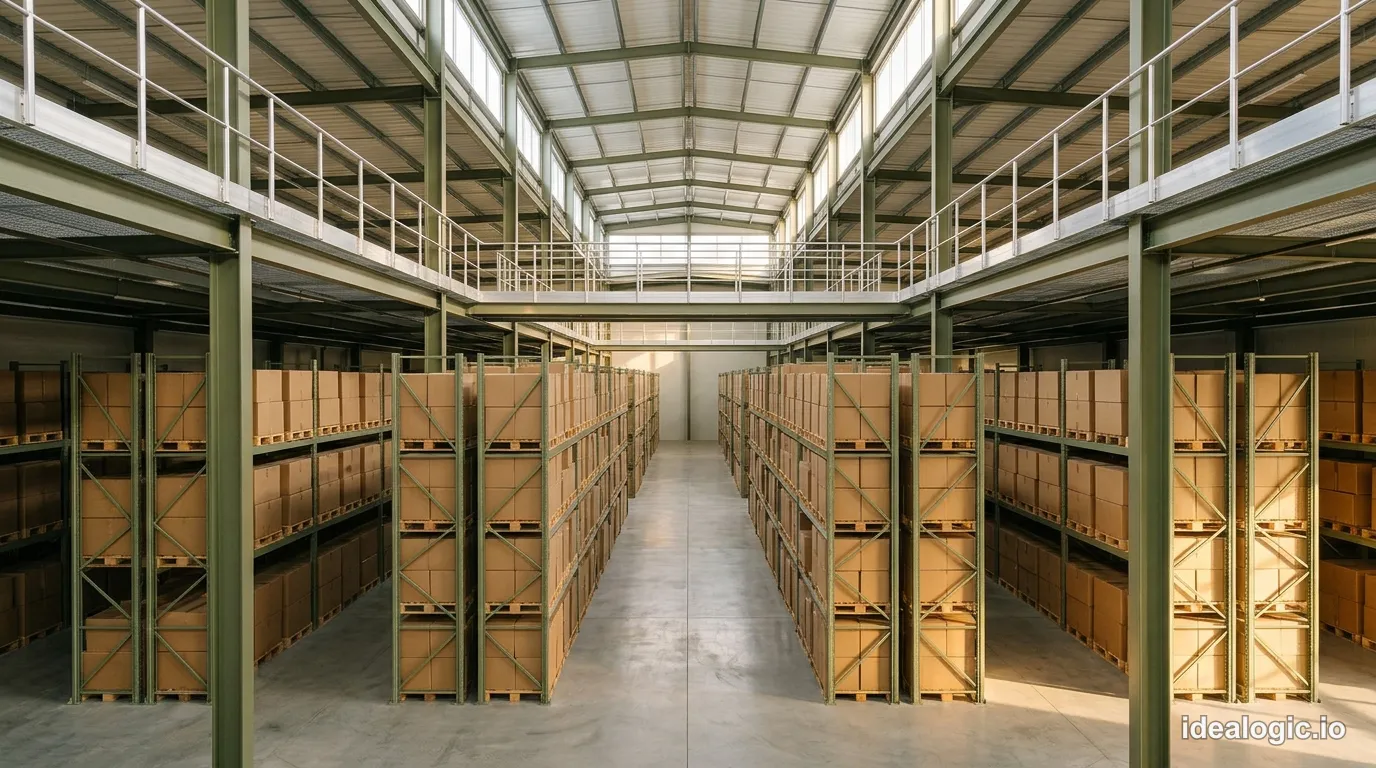
Benchmarking inventory management software cost in 2026 requires comparing two completely different pricing curves because buyers searching the category split right down the middle. Off-the-shelf cloud SaaS subscriptions start at $0 to $249/month for entry tools (Zoho Inventory), climb to $349 to $1,199+/month for mid-market omnichannel platforms (Cin7 Core, while Katana jumps from a 30-SKU free tier to custom ~$1,500+/month Advantage contracts) before per-seat and EDI VAN add-ons, and reach $3,500 to $9,000+/month (plus $50,000 to $150,000+ in systems-integrator fees) for cloud ERP inventory and WMS suites. On the custom engineering curve, aligned with Idealogic's logistics software development and manufacturing software development pricing, an ERP, EDI & Carrier Inventory Integration Sprint starts from $15,000 (4 to 8 weeks), while full custom inventory management software cost runs $45,500 to $73,500 for a Tier 1 barcode MVP, $80,500 to $140,000 for a Tier 2 multi-warehouse omnichannel and EDI platform, and $150,500 to $245,000+ for a Tier 3 RAIN RFID and AI demand-planning system with a senior Central and Eastern European (CEE) squad at $70/hr ($104,000 to $560,000+ at US agencies billing $160/hr).
Most software directories list base monthly SaaS prices while hiding the three multipliers that blow up Year 2 budgets: extra warehouse scanner seats, per-trading-partner 3PL and retail EDI fees, and middleware workarounds when rigid SKU tables hit catch-weight lots, kitting bills of materials (BOMs), or FDA traceability rules. Conversely, software agencies pitch six-figure custom builds to two-person Shopify stores that should simply rent a $349/month tool.
Having built and operated our own HaulBreeze supply chain platform and delivered serialized aviation genealogy on AirpartChain, we price inventory systems from the stock ledger, barcode/RFID hardware bus, and EDI message broker upward. Below is the complete 2026 cost breakdown across commercial SaaS tiers, custom engineering brackets, hardware cost realities, worked 1,400-hour build math, and a 3-year TCO model for a 4-warehouse distributor.
The short version
- Rent SaaS for 1 to 2 standard warehouses; build custom when seats, EDI, or lot physics compound: Below 10 users and 25,000 annual orders with standard integer SKUs, cloud SaaS ($349 to $599/mo) costs $15k to $25k over 3 years and wins easily.
- Start small with an integration sprint when your ERP works: If NetSuite, SAP, or Odoo holds clean financial books but lags on 3PL sync, an ERP, EDI & Carrier Integration Sprint starts from $15,000 (4 to 8 weeks).
- Three custom build tiers ($70/hr Senior CEE vs $160/hr US): Tier 1 Single-Warehouse Barcode & Lot MVP runs $45,500 to $73,500 ($104k to $168k US, aligned with our $45,000 MVP floor); Tier 2 Multi-Warehouse Omnichannel + RF App + EDI runs $80,500 to $140,000 ($184k to $320k US); Tier 3 Enterprise RAIN RFID + EPCIS 2.0 + AI Demand runs $150,500 to $245,000+ ($344k to $560k+ US).
- Hardware economics diverge sharply between GS1 barcodes and RAIN RFID: Rugged Android Zebra barcode guns cost $1,100 to $2,200/unit with sub-cent paper labels, whereas dock-door RAIN RFID portals run $3,500 to $8,500/door plus $0.05 to $0.14 per tagged item.
- 3-year 4-warehouse TCO flips at 35 operators and 8 EDI partners: Over 36 months, a senior CEE custom Tier 2 build ($155,600 all-in) undercuts a mid-market SaaS + EDI VAN stack ($189,000), a US custom build ($292,400), and a cloud ERP WMS suite ($347,000) while eliminating per-seat fees forever.
Off-the-shelf SaaS and ERP inventory software pricing in 2026
Before scoping custom code, benchmark what commercial vendors charge in 2026 and pinpoint the exact ceiling where off-the-shelf pricing breaks:
- Entry SMB cloud inventory SaaS ($0 to $299/month): Tools built for small e-commerce merchants, led by Zoho Inventory pricing ($0 Free tier up to 50 orders/month, Standard through Enterprise tiers scaling from roughly $29 to $249+/month billed annually), sync basic SKU quantities with Shopify, Amazon, and Zoho/QuickBooks accounting. Where teams outgrow it: hard monthly sales-order caps, limited multi-bin directed picking, no native
ASC X123PL EDI translation, and shallow lot genealogy. - Mid-market multi-channel & light-manufacturing SaaS ($349 to $2,500+/month): Platforms such as Cin7 Core and Cin7 Omni pricing (Cin7 Core Standard at $349/mo, Pro at $599/mo, Advanced at $1,199/mo, and Cin7 Omni custom-quoted for multi-entity retail/wholesale) and Katana Cloud Inventory pricing ($0 Free tier capped at 30 SKUs, scaling to custom Advantage annual contracts around $1,500+/mo) add multi-location stock transfers, B2B wholesale portals, and basic BOM assembly. Where hidden costs stack up: base plans often bundle limited seats or SKU tiers; equipping 35 warehouse pickers, purchasing planners, and QA clerks on seat-metered suites adds $900 to $1,500/month in user packs, while connecting external 3PLs and big-box retailers via SPS Commerce fulfillment EDI adds $1,000 to $2,500 setup per partner plus $120 to $250+/partner monthly and per-kilocharacter or per-document overages.
- Mid-market cloud ERP inventory & WMS suites ($3,500 to $9,000+/month + SI fees): Adding Advanced Inventory and Warehouse Management modules inside Oracle NetSuite, Microsoft Dynamics 365 Supply Chain, or Acumatica brings GAAP/IFRS general-ledger integration under one vendor. Where TCO spikes: 35 named plus RF device seats push annual licensing to $60,000 to $110,000/year, third-party systems integrators charge $75,000 to $150,000 upfront to map workflows and EDI sets, and multi-year renewals carry 7% to 10% annual price uplifts.
Custom inventory management software cost by tier in 2026 ($45,500 to $245,000+)
When SaaS seat taxes, EDI VAN tolls, or shop-floor workarounds justify owning your stack, custom inventory management software cost tracks integration count and floor hardware complexity. Grounded in the Eurostat ICT hourly labor cost dataset (lc_lci_lev) (24.00 to 38.40 EUR/hr employer ICT labor cost in Bulgaria, Romania, Poland, and Estonia vs 58.50 EUR/hr in Germany) and US Bureau of Labor Statistics software developer wage benchmarks, senior CEE distributed-systems squads bill $70/hr worked midpoint versus $160/hr at US domestic consultancies.
(Need full four-wall wave slotting and conveyor WES control, or broader freight budgeting? Compare our dedicated warehouse management system development and supply chain software cost guides.)
Worked 1,400-hour breakdown: inside a $98,000 Tier 2 custom inventory build
Here is the exact subsystem ledger for a worked 1,400-hour ($98,000 CEE / $224,000 US) Tier 2 omnichannel inventory platform serving 4 warehouses, e-commerce channels, and external 3PLs:
Four engineering cost drivers underneath accurate inventory software
Why does a real multi-warehouse inventory engine take 1,400 hours while a CRUD tutorial app takes 120 hours? Four engineering realities drive 80% of the budget:
1. Append-only double-entry stock ledgers vs naive integer columns
Junior developers model inventory as UPDATE products SET stock_on_hand = stock_on_hand - 1 WHERE sku = 'A100'. Under concurrent Shopify flash sales, marketplace imports, and counter scans from POS software development lanes, mutable integers suffer lost updates, negative balances, and phantom stockouts that no auditor can explain.
Production systems model inventory identically to a bank ledger: every physical receipt, soft checkout hold, warehouse bin move, BOM assembly consumption, cycle-count variance, and return disposition is an immutable double-entry stock movement row between typed state buckets (on_hand, soft_reserved with 15-minute TTL, hard_allocated, in_transit, qc_quarantine, and damaged). Real-time Available-to-Promise (ATP) computes atomically under PostgreSQL explicit row-level locking (SELECT ... FOR UPDATE ordered deterministically by (facility_id, sku_id) to prevent deadlocks) and emits canonical domain events over an event-driven architecture to downstream order management system channels.
We proved this exact unified-ledger pattern in production on HaulBreeze, joining live inventory balances, automated order transactions, and compliance records onto one canonical data layer with zero nightly reconciliation drift.
2. Barcode (GS1-128 / DataMatrix) vs passive RAIN RFID hardware and middleware math
Floor data-capture technology shifts both software scope and capital hardware capex:
- 1D/2D GS1 barcodes (
$9,800 to $16,800CEE software scope): Parsing AI(01)GTIN, AI(10)Batch/Lot, AI(17)Expiry, AI(21)Serial, and AI(00)18-digit SSCC pallet identifiers under the GS1 General Specifications (plus web-resolvable QR payloads), paired with native Android intents via the Zebra DataWedge API, delivers sub-15ms hardware laser decoding without camera battery drain. Rugged handhelds run $1,100 to $2,200 per unit, and thermal barcode labels cost $0.003 to $0.01. - Passive UHF
RAIN RFIDportals ($26,600 to $45,500CEE software scope): High-velocity apparel, reusable container, medical kit, and aerospace depots deploy passive battery-free tags governed by the RAIN RFID Alliance (ISO/IEC 18000-63/EPC Gen2v2) to read 200+ items inside sealed cartons simultaneously as a forklift drives through a dock portal. The hidden software cost is RF physics: metal racks bounce radio waves and read stationary pallets 30 feet away by mistake. Custom edge middleware must filter raw reader streams (LLRP/ MQTT) using RSSI signal-strength curves, antenna phase-angle vectors, and dock-door photo-eye triggers before committing an inventory receipt. Budget $3,500 to $8,500 per dock door for fixed readers/antennas and $0.05 to $0.14 per item in recurring tag consumables. For bit-level GS1 SGTIN-96 serialization, Impinj and Zebra edge stray-read filtering, EPCIS 2.0 event schemas, and 2-warehouse portal TCO math, read our dedicated RFID inventory management software guide.
3. Lot genealogy, FEFO cold-chain, and BOM transformation rules
Regulated distributors and manufacturers cannot treat two pallets of the same SKU as interchangeable:
- Food, pharma, and aerospace traceability (
+$12,000 to $28,000): Food handlers subject to the FDA FSMA Final Rule on Food Traceability (Rule 204) must capture Key Data Elements across Critical Tracking Events and export sortable electronic recall sheets within 24 hours. US pharmaceutical wholesalers must verify serialized 2D DataMatrix packages under the FDA Drug Supply Chain Security Act (DSCSA), enforcing strict FEFO (First-Expired, First-Out) allocation and locking recalled or temperature-excursion lots instantly. On AirpartChain, our squad engineered OCR + AI extraction and tamper-evident ledger anchoring to track serialized aircraft components across maintenance and supply handoffs. - Kitting, catch-weight, and BOM backflushing (
+$10,000 to $25,000): Protein and chemical distributors track dual units (40 cases =862.4 lbsactual scale weight), while light manufacturers deduct raw components into Work-in-Process (WIP) and finished goods via multi-level BOM backflushing, covered deeply in our manufacturing inventory software guide.
4. Omnichannel APIs, ASC X12 EDI (846/856/940/945), and AI forecasting
Inventory software earns its keep at system boundaries:
- E-commerce and marketplace throttling: Syncing multi-location stock to the Shopify Admin GraphQL API (
inventorySetQuantities) and the Amazon Selling Partner API (SP-API) requires leaky-bucket rate-limit queues and safety-stock buffers so high-velocity drops never trigger API429throttling or marketplace seller-health penalties. - Native
ASC X12EDI &GS1 EPCIS 2.0: Building direct AS2/SFTP parsers for ASC X12 EDI transaction sets (846Inventory Inquiry/Advice,856Hierarchical ASN,940Warehouse Shipping Order,945Shipping Advice, and947Inventory Adjustment) plus GS1 EPCIS 2.0 visibility events eliminates $1,150+/month in per-partner VAN fees. - Pragmatic AI replenishment (
+$14,000 to $32,000): Through our AI integration services, we skip gimmick chatbots and deploy high-ROI operational models: gradient-boosted supplier lead-time and seasonal safety-stock engines that flag impending stockouts by PO lead-time variance, plus OCR pipelines turning supplier PDF packing lists into pre-populated ASN dock receipts.
Companies rarely replace commercial inventory SaaS because the dashboard looks dated. They replace it the month they realize thirty-five warehouse seats, eight 3PL EDI connectors, and two manual spreadsheet reconciliations a day cost more every thirty-six months than owning a purpose-built stock ledger outright.
3-year TCO math: SaaS + EDI vs ERP WMS vs custom build (4 warehouses, 35 users)
Let us put concrete 36-month numbers on a mid-market distributor or brand-manufacturer operating 4 warehouses, 35 total staff (26 Android RF floor operators + 9 planners/managers), 90,000 annual orders, and 8 active retail and 3PL EDI partners (rugged scanner hardware is excluded across all four bars since physical Zebra guns cost the same regardless of software):
Notice what happens after Month 36: when peak season adds 15 temporary pickers or Warehouse #5 opens, SaaS and ERP licenses jump by $12,000 to $24,000/year, whereas your custom platform through our custom software development practice runs on the exact same $650/month cloud cluster with $0 per-user licensing and 100% owned IP.
When NOT to build custom: the 1-warehouse SMB counter-case
We turn down prospective builds whenever off-the-shelf SaaS clearly wins the math. Suppose your D2C or wholesale brand operates 1 warehouse, 5 users, 18,000 annual orders, standard integer SKU quantities, and native Shopify plus QuickBooks Online connectors with zero retail EDI partners:
- Commercial Cloud SaaS (
$16,0643-year TCO): Subscribing to a $349/month mid-market plan ($12,564 over 36 months) plus $3,500 in initial catalog formatting and barcode label setup totals $16,064 over three years and launches in two weeks. - Custom Tier 1 Barcode MVP (
$70,7003-year TCO): Investing $45,500 in a custom single-site MVP plus $25,200 across 36 months of cloud hosting and preventive maintenance ($700/month) totals $70,700. - Honest verdict: Rent the SaaS tool. Keep the $54,636 capital difference inside inventory working capital until multi-site headcount, 3PL EDI volume, catch-weight UOM conversions, or regulated lot genealogy push annual SaaS and workaround spend past $45,000/year.
Three levers to cut v1 custom inventory build cost by 25% to 35% (and SOW audit checklist)
- Keep financial general-ledger accounting inside your existing ERP. Never spend 600 hours rebuilding accounts payable, payroll, or tax filings; treat your custom inventory engine as the sub-150ms operational system of action and post summarized daily COGS and inventory valuation journals (
IAS 2/ASC 330) back to QuickBooks, Xero, NetSuite, or SAP. - Start with GS1-128 / DataMatrix barcodes before RAIN RFID portals. Well-designed directed Zebra
DataWedgebarcode workflows achieve 99.8%+ bin accuracy at one-quarter the capex of fixed dock-door RFID portals; add RAIN RFID in Phase 2 only on high-volume lanes where hands-free portal scans pay back tag costs in under 12 months. - Cut over one warehouse zone first. Shadow-run receiving, putaway, and cycle counting on a single product line or facility for 14 days while verifying daily X12
945/947reconciliation before rolling out network-wide.
Before signing any custom inventory Statement of Work, test competing engineering teams with four architectural verification questions:
- How does your database prevent overselling during simultaneous flash-sale and 3PL updates? Require an append-only movement ledger using deterministic
SELECT ... FOR UPDATErow locks and expiring soft-reservation leases, never optimistic client counters or mutable integer columns. - What happens on a Zebra handheld when Wi-Fi drops inside a -20°C freezer aisle? Verify that pick lists pre-fetch into local SQLite, validate
GS1-128barcodes in under 150 milliseconds locally via nativeDataWedgeintents, and replay signed idempotency keys on reconnect without throwing HTTP conflict screens at forklift drivers. - How do you validate hierarchical
X12 856ASNs before trailer departure? Confirm the pack station binds item GTINs to cartonSSCC-18license plates in real time soShipment -> Order -> Tare -> Pack -> Itemloops never trigger $250 retail compliance chargebacks. - Who owns the source repository, EDI partner maps, and AWS/GCP infrastructure from Sprint 1? Ensure all code, Terraform modules, and AS2 certificates deploy inside your company's own cloud accounts with zero proprietary agency runtime lock-in.
CEO and Co-founder at Idealogic. Leading software strategy, systems architecture, and AI-native engineering squads since 2016.
Frequently asked questions
In 2026, entry-level cloud inventory SaaS platforms such as Zoho Inventory run $0 to $249+ per month for small single-warehouse sellers within strict monthly order caps. Mid-market multi-channel platforms such as Cin7 Core run $349 to $1,199+ per month (while light-manufacturing tools like Katana jump from a 30-SKU free tier to custom Advantage annual contracts around $1,500+ per month) before adding extra warehouse operator seats ($35 to $99 per user monthly), B2B portals, and managed retail or 3PL EDI connectors ($120 to $250+ per trading partner monthly plus $1,000 to $2,500 setup fees). Mid-market cloud ERP inventory suites such as NetSuite or Dynamics 365 typically run $3,500 to $9,000+ per month plus $50,000 to $150,000+ in systems-integrator onboarding.
With a senior Central and Eastern European engineering team billing $70 per hour, custom inventory management software costs $45,500 to $73,500 for a Tier 1 single-warehouse barcode and lot-tracked MVP (650 to 1,050 hours, aligned with Idealogic's $45,000 Logistics and Plant Pilot MVP floor), $80,500 to $140,000 for a Tier 2 multi-warehouse omnichannel platform with offline Android RF scanning and ASC X12 EDI 846, 856, and 940 integration (1,150 to 2,000 hours), and $150,500 to $245,000+ for a Tier 3 enterprise RAIN RFID, GS1 EPCIS 2.0, and AI demand-forecasting platform (2,150 to 3,500+ hours). US domestic agencies charge $104,000 to $560,000+ for the exact same hours, while focused ERP and EDI inventory integration sprints start from $15,000.
Rent off-the-shelf SaaS whenever you operate 1 to 2 standard warehouses with fewer than 10 floor users, standard integer SKU counts, and native Shopify or QuickBooks connectors. At that footprint, a $349 to $599 per month SaaS subscription totals $12,500 to $25,000 over three years and beats custom development cleanly. Custom ownership wins once you cross 3 to 4+ facilities, 25 to 40+ scanner and operations seats, 5 to 10+ EDI retail or 3PL partners, or non-standard catch-weight, kitting, BOM backflushing, or FEFO regulatory workflows where a $155,600 3-year CEE custom TCO undercuts both a $189,000 SaaS-plus-EDI stack and a $347,000 ERP WMS suite.
Software integration for 1D and 2D GS1 barcodes using rugged Android handhelds (such as Zebra terminals running DataWedge intents) adds roughly 140 to 240 engineering hours ($9,800 to $16,800 in CEE), while rugged handheld hardware costs $1,100 to $2,200 per device and barcode labels cost under half a cent each. Upgrading to passive UHF RAIN RFID portals adds 380 to 650 software middleware hours ($26,600 to $45,500 in CEE) for RSSI stray-read filtering and EPC encoding, plus $3,500 to $8,500 per dock-door portal in readers and antennas and $0.05 to $0.14 per item for disposable RFID inlays.
Storing inventory as a single mutable integer column causes race conditions and overselling whenever e-commerce checkouts, marketplace feeds, warehouse pickers, and retail registers update stock concurrently. Production inventory architectures use an append-only double-entry stock movement ledger backed by explicit PostgreSQL row-level locking, tracking separate balances for on-hand, soft-reserved, hard-allocated, in-transit, and quarantined stock to calculate real-time Available-to-Promise (ATP) without drift.
Most SaaS inventory tools do not parse raw ASC X12 EDI files natively. Instead, merchants must buy third-party EDI Value-Added Network (VAN) middleware to translate X12 846 Inventory Inquiry/Advice, 856 Advance Ship Notices, 940 Warehouse Shipping Orders, and 945 Warehouse Shipping Advice. Across 8 trading partners, setup fees of $1,200 per partner plus $1,150 per month in recurring mailbox and document-volume charges add $51,000 over three years before counting retailer ASN compliance chargebacks.
An ERP, EDI, and Carrier Inventory Integration Sprint ships in 4 to 8 weeks starting from $15,000. A full Tier 1 single-warehouse barcode and lot-tracked MVP launches in 8 to 14 weeks, a Tier 2 multi-warehouse omnichannel and EDI platform takes 14 to 22 weeks, and a Tier 3 RAIN RFID and AI forecasting system rolls out over 22 to 34+ weeks. To prevent fulfillment downtime, experienced teams run a parallel zone or single-warehouse shadow cutover for two to three weeks before retiring legacy spreadsheets or SaaS modules.
For a mid-market distributor running 4 warehouses and 90,000 annual orders, managed PostgreSQL, Redis, object storage, and observability on AWS or GCP typically cost $500 to $850 per month ($6,000 to $10,200 per year), with zero per-user or per-order surcharges. Preventive engineering maintenance covering Android OS scanner updates, Shopify or Amazon SP-API version upgrades, and trading-partner EDI map tweaks typically runs roughly 10% to 15% of the initial build cost annually (about $820 to $1,250 per month on a $98,000 CEE build, modeled at $950 per month in our 3-year TCO).
More from the journal

RFID Inventory Management Software: Architecture & 2026 Cost
How custom RFID inventory management software is architected and priced in 2026: RAIN UHF Gen2v2 physics, 96-bit GS1 SGTIN-96 serialization, Impinj and Zebra edge stray-read filtering, EPCIS 2.0 events, hardware budgets, and $45,000 to $225,000+ build tiers.

LIMS Software in 2026: Architecture, Part 11 & Custom Build Cost
Engineering and 3-year TCO guide to LIMS software in 2026: LIMS vs LIS vs ELN vs SDMS boundaries, 96/384-well custody, ASTM/HL7/SiLA 2 analyzer interfacing, FDA 21 CFR Part 11, and custom vs legacy COTS cost.
IoT App Development Cost in 2026: Tiers, Cloud COGS & TCO
IoT software and app development cost in 2026 runs $40,000 to $70,000 for a BLE companion MVP, $75,000 to $140,000 for a commercial fleet platform, and $140,000 to $245,000+ for IIoT. See our 4-layer budget split, 10,000-device AWS MQTT math, and OTA costs.