Geotab vs Samsara in 2026: GO9, APIs, EVs & Fleet TCO
Engineering and 36-month TCO benchmark of Geotab vs Samsara vs Verizon Connect Reveal in 2026: GO9 Curve Logic vs VG55 per-second location updates, MyGeotab GetFeed JSON-RPC vs REST feeds, EV data across 300+ models, and custom middleware.

On this page
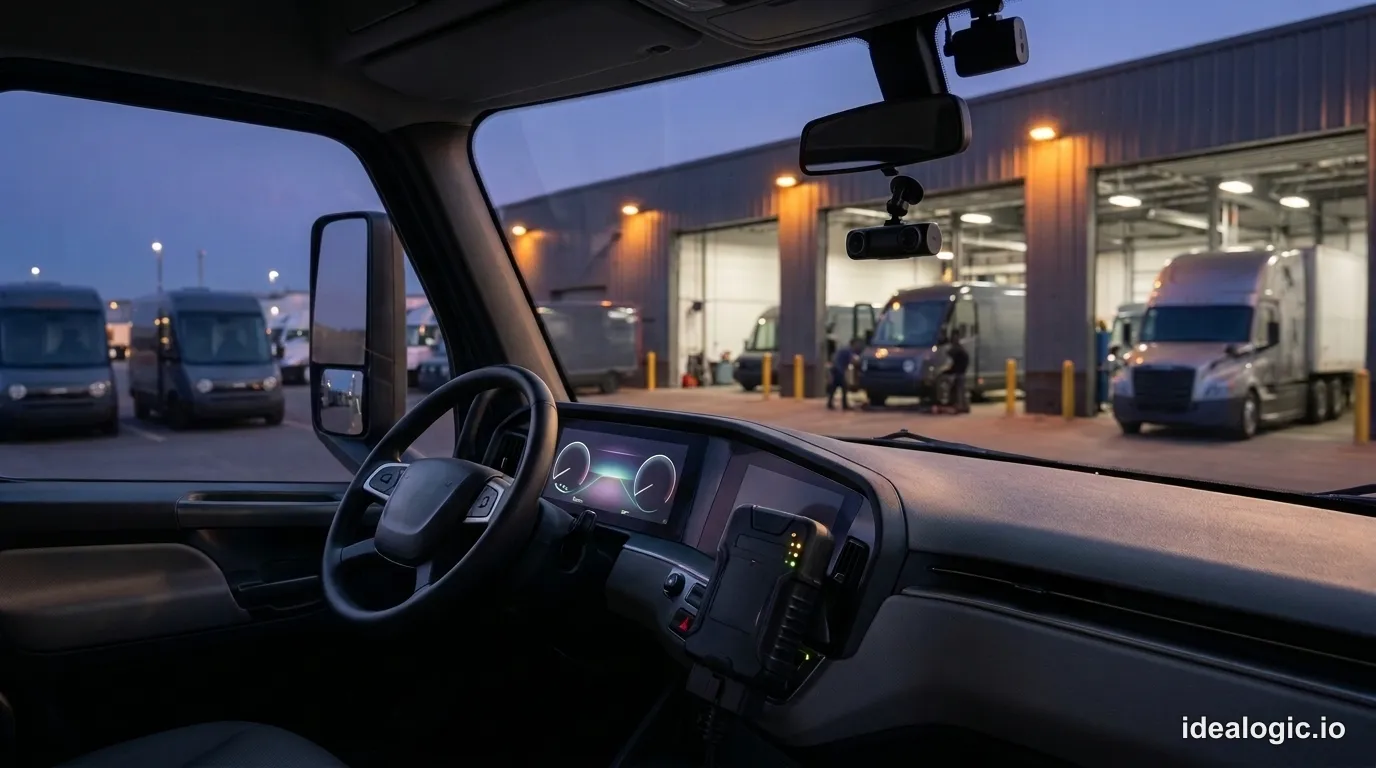
Geotab and Samsara are both fleet telematics platforms, but they sell different things. Geotab sells an open diagnostic platform through resellers, and Samsara sells an integrated hardware, video, and cloud suite. Over-the-road Class 8 trucking RFPs often come down to Samsara vs Motive. If you run a mixed fleet of light, medium, heavy, off-highway, and battery-electric (BEV) vehicles, the choice is usually Geotab vs Samsara, often with a carrier-bundled Verizon Connect vs Samsara quote on the table too.
Whether you search for it as Samsara vs Geotab or the other way round, the two products are built on opposite ideas. Geotab keeps its own hardware small (GO9 and GO9 RUGGED gateways, Curve Logic adaptive logging, battery data across 300+ EV models, IOX expanders), leaves cameras to Marketplace partners, and sells mostly through Authorized Resellers. Samsara builds the whole stack itself: the VG55 gateway with location updates every second, its own dual-facing AI dashcams, one console, and multi-year contracts that typically run 3 to 5 years.
At Idealogic, our logistics and supply chain, AI integration services, and custom software development teams wire MyGeotab, Samsara, OEM EV feeds, and OCPP depot chargers into TimescaleDB and BigQuery data lakes and ERP work-order engines. This benchmark covers CAN and EV diagnostics, GetFeed vs REST cursor APIs, reseller vs direct contracts, and a worked 36-month TCO model for a 120-vehicle mixed ICE and EV fleet, with Verizon Connect Reveal alongside. For the wider category, see our logistics management software guide.
The short version
- Open diagnostics vs one-vendor AI video. Geotab is the stronger pick for CAN depth, battery data across 300+ EV models, IOX expandability, and hardware you own through a reseller. Samsara fits teams that want VG55 gateways and its own AI dashcams in one console, with no third-party camera partner to integrate.
- The two gateways log GPS differently, and that changes pipeline design. Geotab's GO9 uses Curve Logic to record points when heading or speed changes. Samsara's VG55 reports location every second, and you pull those points through
/fleet/vehicles/stats/feed. - Verizon Connect Reveal trades engineering depth for carrier bundling. Reveal packages field-service routing and bundled hardware under one carrier relationship. It trails both rivals on EV data depth, so confirm the contract term, renewal notice, and API access in the order form.
- At 120 mixed vehicles, a lean Geotab setup plus owned middleware has the lowest 36-month TCO in our model: $329,100 with CapEx included, against $482,400 for a full Samsara suite. The vendor prices are illustrative assumptions, and the full table is further down.
Which should you choose
- Mixed municipal, utility, or electrifying fleet that wants to own its hardware: Geotab.
- Uniform commercial fleet that wants gateway, cameras, and driver app from one vendor: Samsara.
- Already on Verizon Wireless and mostly need tracking and dispatch? Get a Verizon Connect Reveal quote, then check what API access it includes.
Geotab vs Samsara in 2026: open diagnostic ecosystem vs vertically integrated cloud
The first difference in Geotab vs Samsara is where each company stops building its own hardware and hands off to partners.
Geotab built a diagnostic telematics core and opened up everything around it. It doesn't make dashcams, temperature probes, or fuel cards. Its hardware is the compact GO9 cab dongle, the IP68 and IP69K rated GO9 RUGGED for yellow iron and municipal snowplows, and the GO Anywhere asset tracker, plus IOX (Input/Output Expander) daisy-chain harnesses. For dual-facing AI video, salt-spreader telemetry, or satellite failover, you add a certified partner from the Geotab Marketplace (Lytx Surfsight, Netradyne, or Sensata, for example) and ingest its events into MyGeotab.
Samsara went the other way and builds everything itself. The VG55 cab gateway, the front and dual-facing AI dashcams, powered and unpowered asset tags, site security cameras, and the driver app are all made, hosted, and licensed by Samsara. The payoff is one browser tab: a harsh-braking event opens next to its synchronized road and cab clip, with no partner sign-on in between. The cost shows up as the fleet grows. Samsara says its contracts are often multi-year, for example 3 to 5 years. You can't swap camera vendors independently of the cab gateway, and maintenance, forms, and BI connectors are priced as separate modules.
Hardware & CAN internals: Curve Logic vs per-second GPS, J1939, and 300+ EV models
On hardware, the two differ in how they log GPS, how far their light-duty and EV decoding goes, and whether you can wire your own sensors into the gateway. What they share is the vehicle's Controller Area Network (CAN), which is where the useful data sits, as our fleet management software guide explains. Both gateways read heavy-duty SAE J1939-71 parameter groups over the RP1226 or 9-pin Deutsch connector, legacy J1708/J1587, and light-duty ISO 15765 frames (the CAN transport for OBD-II and UDS, ISO 14229). Both also meet the Electronic Logging Device (ELD) rules in FMCSA 49 CFR Part 395, Subpart B. They diverge in three places:
- Curve Logic vs per-second logging. Geotab's GO device logging guide covers how the GO9 decides which GPS and accelerometer readings to keep. Curve Logic drops redundant points while a van holds a straight line at constant speed, then logs densely the moment it brakes, swerves, or turns into a customer driveway. Samsara's VG55 takes the simpler route: its datasheet lists location updates every second. That's easier for a customer-ETA widget to render, and it means more rows per straight-line mile in your downstream hypertables.
- Light-duty and EV CAN libraries. OBD-II emissions rules don't standardize passenger-car odometers, seatbelts, or EV battery state of health (SoH). Geotab maintains its own decoding for more than 300 BEV and PHEV models and reads battery data such as state of charge (SoC) and SoH, alongside dongle-free Geotab OEM telematics feeds (Ford Pro, GM OnStar, Mercedes-Benz, Stellantis).
- IOX cab bus vs closed gateway ports. Municipal public-works trucks wire plow-blade sensors, salt-spreader controllers, PTO pumps, and beacon triggers into Geotab
IOX-AUXexpanders and send them as customStatusDatadiagnostics. You don't wait on a vendor roadmap for that.
Dedicated comparison: Verizon Connect Reveal vs Samsara (and Geotab)
Buyers searching verizon connect vs samsara usually run HVAC, plumbing, utility, or regional distribution vehicles and already buy phones and tablets from Verizon Wireless. Verizon Connect Reveal is quote-based, so there's no public list price to compare. Its appeal is bundled trackers with low upfront hardware cost and solid technician dispatching.
From a CTO's seat, two things need checking before you sign. First, the contract: confirm the term, the non-renewal notice window, and what happens to seat counts if you sell vans mid-term. Second, the API: confirm which plan includes API and webhook integrations and how much raw telemetry it exposes. Unless one carrier invoice is your main goal, Samsara is stronger on AI video and developer ergonomics, and Geotab is stronger on CAN and EV diagnostics and contract flexibility.
Geotab vs Samsara API: MyGeotab GetFeed JSON-RPC vs Samsara stats feed
When you wire telematics into an internal ERP, predictive maintenance software, or a depot EV charger controller, the API integration pattern decides how stable the pipeline is. Geotab gives you JSON-RPC feeds, Samsara gives you REST cursors:
- MyGeotab
GetFeed, Data Connector, and Ace. Looping standardGetqueries on MyGeotab's JSON-RPC SDK runs into rate limits and anOverLimitExceptionwith aRetry-Afterheader. Production pipelines callGetFeedper entity (LogRecord,StatusData,FaultData,ExceptionEvent) and pass afromVersioncursor every 5 to 15 seconds to pull only what changed. That stays well inside the 60 requests per minute the API reference lists forGetFeed, and each call returns up to 50,000 records unless an entity has its own cap. For BI without custom ETL, Geotab Data Connector is an OData feed into Power BI or Tableau, and Geotab Ace is an AI assistant for questions about fleet data. - Samsara
/fleet/vehicles/stats/feedand webhooks. Samsara'sGET /fleet/vehicles/stats/feedtakes up to three stattypesper cursor request (for examplegps,obdOdometerMeters, andevStateOfChargeMilliPercent). The rate limit is 150 requests per second per API token and 200 per organization. HMAC-SHA256 signed Samsara webhooks push crash and geofence events as they happen.
Our architects normalize both MyGeotab GetFeed (Curve Logic points plus EV StatusData) and Samsara /stats/feed into one canonical data pipeline table. The Geotab side comes down to one GetFeed call per entity, repeated on a fromVersion cursor, with a retry from the same token after a rate-limit error.
The rest of the worker is plumbing, and these are the decisions that matter in it:
With live ev_soc_pct in a control plane you own, your backend can speak Open Charge Point Protocol (OCPP 1.6J or 2.0.1) directly to depot Level 2 and DC fast chargers. A typical rule: throttle vehicles already at 75% SoC during the 4:00 PM to 9:00 PM peak-demand window, and prioritize trucks scheduled for 5:00 AM winter routes.
Geotab vs Samsara TCO: worked 36-month model for a 120-vehicle mixed ICE + EV fleet
This is 36-month cash math for a 120-vehicle municipal, utility, or regional field-service fleet: 80 diesel and gasoline box trucks, bucket vans, and pickups, 40 battery-electric vans across 3 depots, and 30 ruggedized trailers and generators. One caveat first. Samsara and Verizon Connect publish no list prices, and Geotab plans and prices vary by reseller, so every vendor price here is an illustrative assumption, not a quote. Option C also isn't like for like: it trades 60 fewer cameras for an owned build.
Engineering labor uses Idealogic's 2026 benchmark: $50 to $75/hr ($75/hr blended senior CEE architect + squad) versus $150 to $210/hr ($165/hr blended) US domestic. For context on the gap, see the Eurostat hourly labor cost dataset (lc_lci_lev) and US BLS OES wage data for Software Developers (15-1252):
- Option A: Samsara Full Enterprise Suite (120 VG55 + Dual AI Dashcams + EV/Forms/BI + 30 Asset Trackers, 36-mo contract): $14,400 cab/asset install (120 x $110 + 30 x $40) + $345,600 vehicle telematics & dual AI cameras (120 x $80/mo x 36) + $90,000 EV/Forms/BI & 30 asset tags ($1,440 EV/Forms + $480 asset tags + $580 BI connector = $2,500/mo x 36) + $32,400 internal IT/ERP reconciliation (12 hrs/mo @ $75/hr x 36) = $482,400 ($156,000/yr renewal run-rate).
- Option B: Geotab ProPlus (GO Plan) via Reseller + Marketplace Dual AI Camera (120 vehicles + 30 GO Anywhere, 36 mos): $62,400 upfront owned hardware & install (120 GO9/GO9 RUGGED @ $135 = $16,200 + 120 Marketplace AI cams @ $240 = $28,800 + 30 GO Anywhere @ $130 = $3,900 + $13,500 install) + $259,200 ProPlus & AI video plans (120 x $60/mo [$32 ProPlus + $28 video] x 36) + $54,000 Data Connector, 30 asset SIMs & EV add-on ($420 + $360 + $720 = $1,500/mo x 36) + $43,200 dual-portal IT & ERP stitching (16 hrs/mo @ $75/hr x 36) = $418,800 ($118,800/yr post-hardware renewal run-rate). (By comparison, Verizon Connect Reveal + Video + API add-ons on a 36-month contract lands at $400,800: $12,000 install + 120 x $65 x 36 = $280,800 + $1,950/mo x 36 = $70,200 API add-ons/assets + $37,800 ops at 14 hrs/mo, $129,600/yr run-rate).
- Option C: Lean Geotab ProPlus + OEM EV Feeds + Owned Custom Data Lake, OCPP EV Scheduler & PdM Middleware (1,280 hrs CEE build): $132,000 CapEx (1,280 hrs @ $75/hr = $96,000 CEE vs $211,200 US, plus $36,000 selective hardware/install: 80 GO9 on ICE trucks $10,800, $0 dongles on 40 OEM-connected BEVs, 60 heavy-truck AI cameras $13,200, 30 asset tags $3,600, install $8,400) + $145,440 lean subscriptions (80 x $29 ProPlus $2,320 + 40 x $16 OEM EV feeds $640 + 60 x $18 video $1,080 = $4,040/mo x 36) + $27,360 AWS TimescaleDB/Google BigQuery & 30 asset SIMs ($460 + $300 = $760/mo x 36) + $24,300 automated ops (9 hrs/mo @ $75/hr x 36) = $329,100 ($65,700/yr Years 4 to 5 run-rate, before counting avoided peak-demand utility charges, which we estimate at $18,000 to $32,000/yr).
Post-launch monthly OpEx drops from $13,000/mo (Samsara) and $9,900/mo (Geotab + Cam) to $5,475/mo. That repays the net CapEx delta in 15.6 months vs Samsara and 15.7 months vs Geotab, and it loosens vendor lock-in.
When to buy turnkey vs build custom telematics, EV & ERP middleware (2026 costs)
Below 60 uniform vehicles, with no custom ERP and no depot EV charging constraints, just license Samsara (for turnkey AI video) or Geotab ProPlus (for diagnostic breadth). Four triggers justify building your own middleware layer, in line with our supply chain software cost and predictive maintenance software benchmarks:
- Mixed ICE + BEV depot electrification (25+ EVs): Joining MyGeotab or OEM SoC feeds with OCPP smart-charger curtailment to avoid utility demand spikes, which we estimate at $1,500 to $3,000/mo for a depot this size.
- Automated J1939 DM1 & EV fault-to-CMMS work orders: Suppressing cold-start nuisance codes and opening parts-reserved SAP, Maximo, or custom CMMS tickets automatically.
- Post-M&A or municipal multi-vendor fleets: Unifying legacy Geotab public-works trucks, Samsara linehaul tractors, and OEM Ford Pro/GM service vans onto one map without breaking mid-term contracts.
- Single-pane Geotab + third-party camera UX: Merging MyGeotab Curve Logic trips and Marketplace camera clips inside your own supervisor coaching dashboard.
Every tier pairs Idealogic's senior CEE hourly rates ($75/hr blended vs $165/hr US) with explicit squad sizes:
Inside the worked 1,280-hour ($96,000 CEE vs $211,200 US) middleware build
- 1. MyGeotab
GetFeed, Samsara & OEM Ingest (30% / 384 hrs / $28,800 CEE vs $63,360 US): Fault-tolerant JSON-RPCGetFeedtoken workers, Samsara/stats/feed& webhook consumers, Curve Logic trajectory interpolation, and Ford Pro/GM OEM EV adapters. - 2. OCPP EV Smart-Charge & SoC Scheduler (25% / 320 hrs / $24,000 CEE vs $52,800 US): OCPP 1.6J/2.0.1 depot charger load balancer matching live vehicle SoC and next-morning route kWh demand against off-peak utility tariffs.
- 3. J1939 Fault & PdM Work-Order Engine (20% / 256 hrs / $19,200 CEE vs $42,240 US): DM1 (PGN 65226, SAE J1939-73) and EV battery thermal anomaly classifier creating idempotent SAP, Maximo, or CMMS work orders with spare-part SKUs.
- 4. Unified Safety Video & Coaching Console (15% / 192 hrs / $14,400 CEE vs $31,680 US): Single-pane supervisor portal joining Geotab
ExceptionEventrules with Lytx/Netradyne or Samsara clip URLs and driver sign-off workflows. - 5. TimescaleDB, BigQuery Sync, IaC & QA (10% / 128 hrs / $9,600 CEE vs $21,120 US): Columnar hypertable compression, BigQuery analytical sync, Terraform Multi-AZ AWS ECS/RDS, and 25,000-row
GetFeedburst tests.
Geotab gives engineers the richest CAN and EV diagnostic stream in commercial telematics, while Samsara packages the cleanest turnkey camera cloud. The mistake is letting either vendor's portal become your system of record: ingest raw GetFeed and stats/feed deltas into your own TimescaleDB schema so cab hardware stays swappable and your ERP, CMMS, and EV chargers run on one brain.
Shipped Idealogic fleet & asset proof + 5-point CTO decision checklist
Idealogic has shipped fleet, supply-chain, and regulated asset-tracking platforms that run in production:
- VIN-level fleet & carrier TMS (Conveya): An auto-transport carrier and broker platform with VIN-level quoting, USDOT/FMCSA lane matching, live shipment telemetry, and automated settlement records.
- Zero-batch real-time SCM (HaulBreeze): Idealogic's single-layer supply-chain platform, which unites live order state, inventory, validated bulk ingestion, and automated compliance documents.
- Tamper-evident MRO & asset traceability (AirPart Chain): Component-level lifecycle and maintenance history tracking across multi-party aviation maintenance networks, where every record has to be auditable.
Run five final checks before choosing Geotab vs Samsara, signing a 36-month telematics contract, or contacting our architects:
- Mixed municipal, utility, or EV-transitioning fleet (300+ EV models, plows, PTO sensors, hardware ownership)? Pick Geotab ProPlus (GO9 / GO9 RUGGED) through a vetted Authorized Reseller.
- Uniform commercial fleet that wants turnkey AI dashcams and driver workflows in one UI? Pick Samsara (VG55 plus its own dashcams) and cap add-on escalators in writing for the full term.
- Evaluating Verizon Connect Reveal? Confirm which plan includes raw API access, then calendar the renewal notice window on Day 1.
- Polling MyGeotab at scale? Ban looped
Getqueries; persistGetFeedtoVersioncursors per entity and honorOverLimitExceptionRetry-Afterheaders. - Operating 25+ depot EVs or multiple ELD brands? Fund a $72k to $135k CEE normalization and OCPP smart-charging layer instead of paying for a full video and telematics bundle on all 120 units.
CTO and Co-founder at Idealogic. Directing engineering, systems architecture, security, and full-stack delivery across web, mobile, and blockchain.
Frequently asked questions
Choose Geotab when your fleet mixes light, medium, heavy, off-highway, and battery-electric vehicles and you care more about battery and CAN data across 300+ EV models, IOX cab expandability, reseller terms, and the raw MyGeotab SDK than about one vendor building the dashcam. Choose Samsara when you want a single vendor for the VG55 gateway, its own dual-facing AI dashcams, driver workflows, and executive dashboards, and you can accept a multi-year contract, typically 3 to 5 years.
Samsara's VG55 datasheet lists location updates every second, so the gateway reports points at a fixed rate. Geotab's GO9 uses Curve Logic, an adaptive logging method that saves a point when heading or speed changes enough to matter and skips redundant points on a straight, steady stretch. You get fewer rows with the corner and braking detail intact. The catch is that downstream ETA engines have to interpolate between points on long highway runs.
MyGeotab exposes a JSON-RPC API. High-volume pipelines call GetFeed with a fromVersion token to pull incremental LogRecord, StatusData, FaultData, and ExceptionEvent changes instead of re-querying live data, and Geotab adds Data Connector (an OData feed for BI tools) and the Geotab Ace AI assistant on top. Samsara exposes REST cursor pagination through GET /fleet/vehicles/stats/feed (150 requests per second per API token, 200 per organization), HMAC-SHA256 signed webhooks, and a Kafka connector. Samsara is quicker to wire up for webhooks. MyGeotab goes deeper on proprietary OEM fault and EV battery data.
Geotab keeps its own engineering on GO9, GO9 RUGGED, and GO Anywhere firmware, CAN and OBD decoding, and the MyGeotab cloud. Authorized Resellers handle hardware fulfillment, cab installation, billing, and plan packaging, so plan names and prices vary by reseller and market. Through that channel you can own the hardware outright and pair it with Marketplace cameras such as Lytx Surfsight or Netradyne. The downside is video coaching across two portals, unless you unify them behind custom middleware.
Verizon Connect Reveal bundles GPS tracking, field-service scheduling, and optional dashcams, and its pricing is quote-based. It suits HVAC, plumbing, and regional delivery fleets already on Verizon Wireless billing. Before you sign, check the contract term, the renewal notice window, and which plan includes API access. For engineering-led fleets, its developer API surface and EV battery diagnostics trail both MyGeotab and Samsara.
Geotab leads on EV breadth. It supports more than 300 BEV and PHEV makes and models, reading battery data such as state of charge and state of health, alongside OEM telematics connectors. Samsara has clean EV state-of-charge dashboards and charging alerts for mainstream vans and trucks. Neither vendor natively orchestrates OCPP 1.6J or 2.0.1 depot charger load balancing against utility peak-demand tariffs, which is why growing EV depots add custom charge-scheduling middleware.
In our worked model for a 120-vehicle municipal, utility, or regional distribution fleet (80 diesel and gas trucks and vans, 40 battery-electric vans, plus 30 tracked trailers and generators), 36-month TCO reaches $482,400 on a full Samsara suite, $418,800 on Geotab ProPlus with a Marketplace dual AI camera bundle, and $400,800 on Verizon Connect Reveal with video and API add-ons. The vendor prices are illustrative assumptions, not list prices. A lean Geotab setup on 80 ICE trucks, dongle-free OEM feeds on 40 BEVs, and an owned 1,280-hour ($96,000 CEE) data lake, OCPP charge scheduler, and CMMS middleware totals $329,100 with CapEx included. That's $153,300 less than Samsara and $89,700 less than full-bundle Geotab, though the lean option carries 60 cameras instead of 120, so the comparison isn't like for like.
Engineering a production multi-telematics ingestion pipeline (MyGeotab GetFeed, Samsara stats/feed, and OEM EV APIs), OCPP depot smart-charge scheduler, SAE J1939 fault-to-CMMS work-order engine, and unified safety dashboard runs $72,000 to $135,000 over 14 to 20 weeks with an Idealogic senior Central and Eastern European squad at $50 to $75 per hour ($75 per hour blended worked 1,280-hour model = $96,000 CEE, versus $211,200 at $165 per hour US domestic). Ongoing dedicated pods start from $18,000 per month CEE versus $39,600+ per month US for 2 to 3 senior engineers.
More from the journal
PlanetScale vs Neon in 2026: Metal NVMe, CoW & PG17 TCO
Engineering and 36-month TCO teardown of PlanetScale for Postgres vs Neon (Databricks) and AWS Aurora I/O-Optimized in 2026: local NVMe Metal unlimited IOPS vs disaggregated Pageservers, CoW branching, Neki sharding preview, FORCE RLS on PG17, and 1.2 TB math.

SigNoz vs Datadog in 2026: OTel, ClickHouse & APM TCO
Engineering and 36-month TCO teardown of SigNoz vs Datadog and Grafana Cloud in 2026: OpenTelemetry Collector tail-sampling, unified ClickHouse telemetry, p99 host high-water-mark billing, PG17 FORCE RLS alert planes, and 150-host math.

GrowthBook vs LaunchDarkly in 2026: Flags, CUPED & TCO
Engineering and 36-month TCO benchmark of GrowthBook vs LaunchDarkly in 2026 alongside Statsig (OpenAI / Amplitude) and CNCF OpenFeature: warehouse-native CUPED SQL, client MAU vs $40/seat billing, PG17 SSE providers, and 500k-MAU math.