Order Management System: How It's Built
An order management system orchestrates an order from any channel to delivery. Here's the core services, the inventory and ATP logic, distributed order management, the EDI integrations, and what it takes to build.

On this page
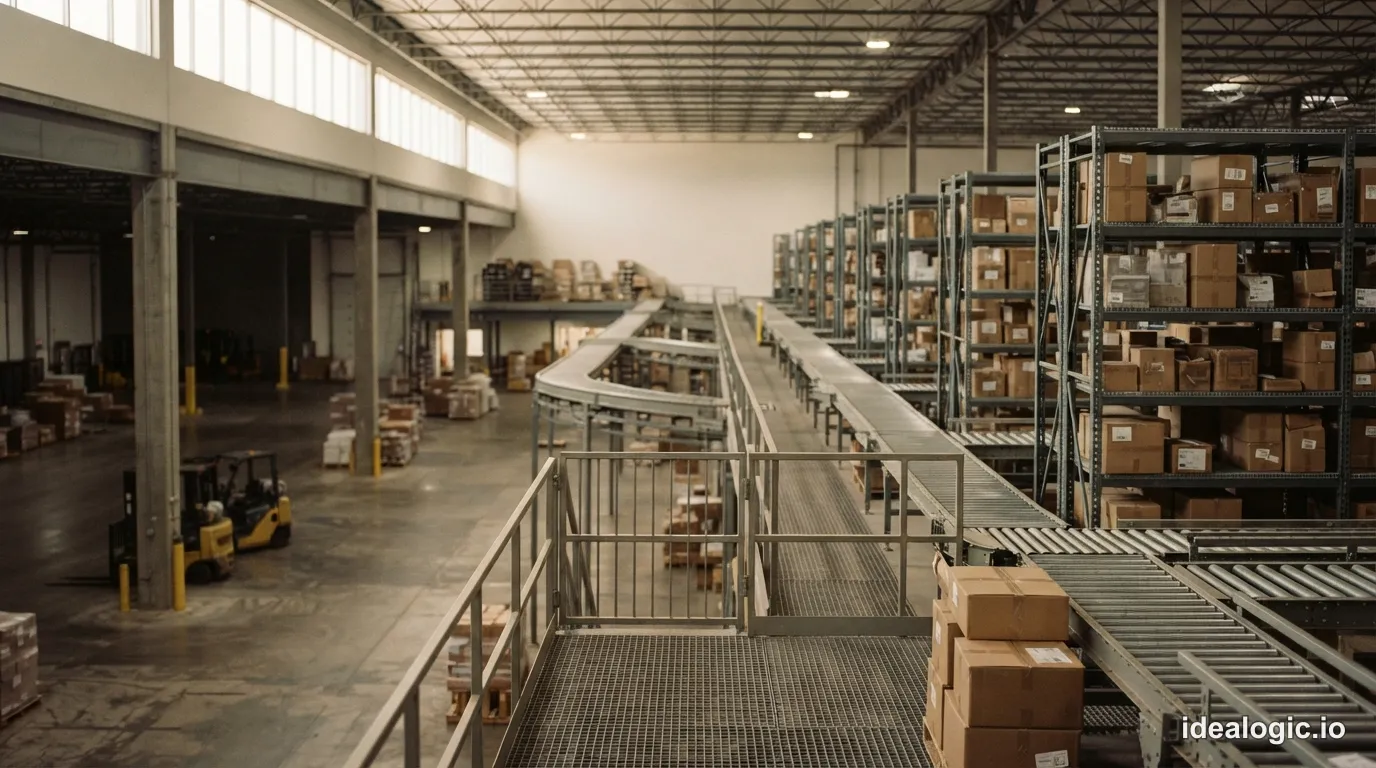
An order management system is the software that takes an order the moment it is placed in any channel and orchestrates it through validation, inventory reservation, sourcing, fulfillment, shipping, settlement, and any return that follows. You meet one every time you buy. When a website says an item is in stock, charges your card, and ships it from a store forty miles away instead of a distant warehouse, an order management system made that call. It sits above your warehouses, channels, and finance system, holding the one true answer to a deceptively hard question: what was ordered, where is it, and what happens next.
This guide is written from the builder's chair. Most explainers of an order management system are vendor pages arguing why you should license theirs. This one covers the parts those pages skip: how the core services fit together, how the inventory and sourcing logic works, where the integration risk lives, and when a custom build beats an off-the-shelf product. If you run fulfillment or own a commerce platform and you are weighing whether to build or replace your OMS, this is the framing we use when we scope one.
The short version
- An order management system orchestrates an order from capture in any channel through validation, inventory reservation, sourcing, fulfillment, shipping, settlement, and returns, and it is the single source of truth for what was ordered and where it stands.
- The boundaries are clean: the e-commerce platform sells, the OMS orchestrates and usually holds cross-channel inventory truth, the warehouse management system executes inside one site, and the ERP keeps the books.
- The architecture is a set of focused services (order capture, inventory and ATP, sourcing, fulfillment, returns) wired to a central event bus and an order state machine that records every transition.
- Available-to-promise is on-hand stock minus what is already allocated plus trusted inbound supply, computed in real time across every channel so the same unit is never sold twice.
- Distributed order management is the sourcing engine that scores every eligible location on cost, distance, delivery promise, and inventory balance, then fulfills from one node or splits the shipment, which is what powers ship-from-store and BOPIS.
- The integration layer, spanning channel APIs, EDI documents (X12 850, 855, 856, 810), carriers, payment, and the ERP, is the hardest and most valuable part of the build and the main driver of cost and timeline.
What an order management system actually is, and the order lifecycle it owns
An order management system is the orchestration layer that owns an order from the instant of capture through to delivery and return, coordinating every system that touches it without doing any one of their jobs. It is not the store, not the warehouse, and not the accounting ledger. It is the conductor that tells each of those when to act and records what they did. Order management software earns its keep by being the single place where the full state of an order lives, so nobody stitches together three systems to find where a customer's package is.
The clearest way to understand an OMS is to follow the lifecycle it governs, because that lifecycle is also the map for the rest of this article. An order moves through a fixed set of stages. Capture brings the order in from whatever channel placed it. Validation checks that the order is sane: real address, valid payment, sellable items. Allocation reserves inventory so it cannot be sold twice. Sourcing decides which location or locations should fulfill it. Fulfillment hands the work to a warehouse or store and tracks the pick, pack, and ship. Shipping books the carrier and emits tracking. Settlement captures payment, and returns reverse the flow when goods come back. Every section below drills into one part of this chain. Hold the lifecycle in your head and the architecture stops looking like a pile of services and starts looking like a pipeline.
OMS vs WMS vs ERP vs your e-commerce platform: who owns what
The fastest way to design an order management system badly is to let it bleed into the jobs of the systems around it, so the first task is drawing clean boundaries. The short version: your e-commerce platform sells, the OMS orchestrates, the warehouse management system executes, and the ERP keeps the books. Three questions settle most arguments: who is the inventory source of truth, who decides what happens to an order, and who does the physical work.
The OMS is the orchestrator and, in most modern setups, the inventory source of truth across channels, because it is the only system that sees demand from every channel and supply from every location at once. The warehouse management system is the executor inside one building; for that depth, see our guide to warehouse management system development. The e-commerce platform is a channel that captures orders and hands them off, and the ERP is the financial system of record the OMS feeds and reads. When a platform tries to do all four, you get a system mediocre at each. When the umbrella spans transportation and warehousing as one product, that is a different scope, covered in logistics management software.
Inside the architecture: the core services of an OMS
An order management system is built as a set of focused services connected by an event bus, with an order state machine at the center recording every transition. No single service owns the whole order. Each owns one stage of the lifecycle and emits events as it works, and a durable order record advances through its states as those events land. The quality of these boundaries is most of what separates an OMS that scales from one that turns into a tangle of cross-calls a year after launch.
Read the services in the order an order travels. The order-capture API is the front door: a normalizing endpoint that accepts orders from every channel and turns them into one internal order shape before anything downstream trusts them. The inventory and ATP service owns stock positions across locations and answers the available-to-promise question, holding reservations so an item is never sold twice. The sourcing and orchestration engine is the brain: it decides which location or locations fulfill the order and in what split. The fulfillment service turns that decision into work, sending requests to a warehouse management system or a store app and tracking the pick, pack, and ship back. The returns service runs the reverse flow and feeds stock back into inventory. Underneath all of them, the event bus and order state machine carry messages between services and keep the canonical record of where each order stands. The table lays out each service, its responsibility, and the boundary it must not cross.
The cross-cutting discipline matters as much as the services. The order state machine must enforce legal transitions, so an order cannot ship before it allocates, and every transition is logged to an append-only history that is both audit trail and debugging tool. Idempotency protects against the asynchronous mess of real systems, because a carrier webhook or a retried capture call must move the order forward once, not twice. We build this layer on a default stack: Node.js and Python services behind a React and React Native front end, PostgreSQL with PostgreSQL row-level security as the multi-tenant system of record alongside Redis for caching and queues, on AWS or GCP through Terraform. The custom software development page covers how we approach builds of this kind.
Inventory allocation and available-to-promise (ATP) logic
Allocation is the OMS function that reserves stock against an order so the same unit is never promised to two customers, and available-to-promise is the calculation that decides what you can sell right now. Get this wrong and you either oversell, which means cancellations and angry buyers, or undersell, which means inventory sitting idle while the site says out of stock. Both are expensive, and both come down to how the inventory and ATP service does its arithmetic.
Allocation comes in two forms, and a real OMS uses both. Soft allocation is a tentative hold placed at order capture, a reservation that says this stock is spoken for but not yet committed to a physical pick. Hard allocation commits specific units at a specific location once sourcing has decided where the order ships, locking the stock to that fulfillment. The window between the two is where most oversell bugs live, so the service treats reservations as first-class records with expiry, not as a number it decrements and hopes about.
Available-to-promise is the number the rest of the business leans on, and the honest definition is on-hand stock, minus what is already allocated, plus inbound supply you are confident will arrive, often with a safety-stock buffer held back so you never promise the last unit into a race condition. The size of that buffer is not the OMS's decision: it comes from the inventory policy set upstream by supply chain planning software, and the OMS reads it as an input. The hard part is that this must be computed in real time and consistently across every channel at once, because web, marketplace, and store all draw from the same pool, reconciled against physical pallet and carton receipts tagged with GS1 Serial Shipping Container Codes (SSCC) and GS1 EPCIS 2.0 (ISO/IEC 19987) scan events. The defensive move is to make ATP a single authoritative service that every channel queries, and to make the reservation operation atomic so two simultaneous orders for the last unit cannot both succeed. Oversell protection is not a feature you bolt on later; it is a property of how you model reservations from the first commit. Keeping that stock count accurate end to end is central to supply chain visibility software, where this number comes from and goes to.
Distributed order management: the fulfillment sourcing engine
Distributed order management, often abbreviated DOM, is the capability that lets an order management system fulfill from many locations instead of one, scoring every eligible node and choosing the best place or places to ship from. A simple OMS routes every order to one warehouse. A distributed one treats your whole network, every internal warehouse, every partner facility running 3PL software, every store with back-stock, and every drop-ship vendor, as a pool of supply and decides per order how to use it. This is where omnichannel order management becomes an algorithm.
The engine is rules-based, and it works by node scoring. For a given order, it filters to locations that have the inventory, then ranks them against a weighted set of factors: shipping cost to the customer, distance and the delivery promise it can hit, the inventory balance across the network so one location is not drained while another sits full, and any service-level commitment the order carries. The output is a sourcing plan: fulfill the whole order from one node, or split the shipment across several when no single location can cover it. Split shipments cost more but save the sale when stock is scattered.
The payoff is that the fulfillment patterns customers now expect fall out of this one engine rather than each needing a bespoke build. Ship-from-store is the sourcing engine treating stores as nodes. Buy-online-pickup-in-store, or BOPIS, is the engine sourcing to the store the customer chose and routing the work to a store-associate app instead of a carrier. Tune the scoring weights and the network behaves differently without new code, which is why teams with unusual fulfillment needs outgrow a packaged product here. When the chosen node dispatches on a private vehicle fleet or local courier, the handoff runs into fleet management software and the delivery tooling we cover in last-mile delivery software.
The teams that win at order management treat the sourcing engine as the product, not a setting. The order screen is the easy week. The node scoring, the reservation model, and the one connected inventory truth underneath are the build.
Omnichannel order capture: one order, many channels
Omnichannel order capture is the function that takes orders from every selling channel and turns each one into a single internal order model, so the rest of the OMS never has to know where an order came from. A web order, a marketplace order, a point-of-sale sale, and a B2B purchase order arrive in wildly different shapes, with different fields, identifiers, and assumptions. If those differences leak past the front door, every downstream service has to special-case the channel and the system rots.
The pattern is a normalizing adapter per channel feeding one canonical order shape. Each adapter knows the quirks of its source: the e-commerce platform posts orders over a webhook or API, the marketplace has its own format and its own rules about acknowledgment timing, the point-of-sale system streams completed sales that are already paid, and the B2B channel arrives as an EDI document that has to be translated. The adapter's only job is to map that input into the internal model and reject what is malformed, so that by the time an order reaches validation and allocation, the engine sees one consistent thing. The same OMS then pushes status back out to each channel in that channel's own language, the mirror image of capture. Treating capture and status-back as a clean adapter boundary is what lets you add a channel later without reopening the core.
Returns and RMA as part of the order lifecycle
Returns are the reverse leg of the order lifecycle, and a real order management system treats a return as a first-class flow rather than an afterthought bolted on once the package is gone. The order does not end at delivery. A meaningful share of what ships comes back, and the system that orchestrated the outbound order is the natural place to orchestrate the inbound one, because it already holds the order history, the payment, and the inventory truth that a return touches.
The flow starts with a return merchandise authorization, the RMA, the record that says this customer may send these items back under these terms. From there the OMS runs the reverse path: it generates the return, hands off to reverse-logistics tooling for the label and inbound shipment, receives the goods, inspects and dispositions them, and triggers the refund or exchange against the original order. Each of those is a state on the same order record. The return shipment uses the same carrier and tracking layer the outbound did, which we cover in transportation management system.
The part teams underestimate is the effect on available-to-promise. A returned unit is supply, and the question is when it counts. Promise it the moment the RMA is created and you risk selling stock that may arrive damaged or never arrive. Wait until it is received and inspected and you leave good inventory off the shelf too long. The right answer is usually to bring returned stock back into ATP only after disposition confirms it is sellable, which keeps the promise honest. Returns are where the inventory model, the payment model, and the order state machine all meet.
Integrations: EDI 850, 855, 856, 810 and APIs
Integrations are where an order management system earns or loses its value, because an OMS that cannot talk cleanly to channels, carriers, payment, and the warehouse is just an expensive database. The integration surface splits into two worlds: the modern API world of REST, webhooks, and SDKs, and the older but still dominant world of electronic data interchange, or EDI, that runs B2B trade. A serious OMS speaks both, and the EDI side is where builders underestimate the work.
The order EDI documents are standardized transaction sets, and the canonical set in North America is X12, maintained in the ASC X12 EDI transaction sets. Four of them carry the commercial order, alongside the 940 warehouse shipping order and 945 warehouse shipping advice for 3PL fulfillment. The 850 is the purchase order: a buyer sending an order to a supplier. The 855 is the purchase order acknowledgment: the supplier confirming receipt and whether it can fill the order as requested. The 856 is the advance ship notice, or ASN: the supplier telling the buyer what is shipping, in what cartons, before it arrives, so receiving knows what to expect. And the 810 is the invoice: the supplier billing for what shipped. Outside North America, international retail and wholesale lanes exchange the equivalent UN/EDIFACT ORDERS, ORDRSP, DESADV, and INVOIC messages. An OMS serving B2B customers has to consume and emit these correctly, including the acknowledgment timing and line-level detail that trading partners enforce. The table lays out each set, its purpose, and which way it flows.
The API side is broader but more familiar. Marketplaces expose order and inventory APIs with their own rate limits and acknowledgment rules. Carriers offer parcel rating, label, and tracking APIs the shipping step calls, while cross-border inbound replenishment and outbound freight legs integrate ocean container milestones via DCSA standards, air cargo tracking via IATA ONE Record, US motor-carrier hours-of-service constraints under FMCSA 49 CFR Part 395, and European digital transport reporting under the EU eFTI Regulation (Regulation (EU) 2020/1056). Payment integration authorizes funds at capture and settles on fulfillment using tokenized payment credentials compliant with PCI DSS v4.0.1, with idempotent calls so a retry never double-charges. The ERP link feeds master data and orders in and pushes settlement back. Inventory sync runs constantly between the OMS and the warehouse management system, because the ATP number is only as good as the stock counts feeding it. The integration layer, not the screens, is what sets the timeline on an OMS build.
Build vs buy: when a custom OMS makes sense
The build-versus-buy decision for an order management system comes down to one question: is your order flow a commodity that fits a packaged product, or is it the thing that makes you competitive? For a great many businesses the honest answer is buy. A platform-native OMS that ships with your commerce platform, a composable OMS assembled from API-first components, or an enterprise OMS suite will cover a standard retail flow well, and rebuilding that from scratch is waste.
Custom earns its place at the edges, where packaged products start fighting how you work. A few patterns recur. Unusual sourcing rules are the most common: when your fulfillment logic depends on factors a vendor's rules engine cannot express, the sourcing engine becomes the reason to build. Unique service-level commitments, such as promises tied to contracts, regions, or customer tiers that a packaged tool cannot model, push the same way. And the M&A system zoo, where a company has grown by acquisition and now runs three order systems and two inventory truths, often needs a custom orchestration layer because no off-the-shelf product was built to sit across that mess. In each case the trigger is the same: the part of your order flow that differentiates you is the part the product cannot bend to.
The framework generalizes beyond the OMS, and it is the same call you make on any major system: buy the commodity, build the differentiator. The category names above, enterprise suite, composable, platform-native, are architecture choices, not rankings, and the right one depends on your flow rather than a feature grid. When a custom build is justified, scoping it against a product development team turns the decision into a plan.
What an OMS build costs
The cost of building an order management system scales with how much order complexity you take on, so the only honest way to talk about it is in scope tiers rather than a single number. For context, the order-management software market is estimated in the several billions of dollars in 2025 and growing on e-commerce demand, though market-research estimates vary widely by how the category is drawn. That number tells you the demand is real; it tells you nothing about your build, which is driven by your integrations, migration, and sourcing rules, not the size of the market.
Three drivers move the figure more than anything else. The integration surface is usually the biggest: every channel, EDI trading partner, carrier, payment, and ERP connection is its own piece of work with its own quirks. Data migration is the quiet cost when you replace a legacy OMS, because moving open orders, inventory positions, and history without dropping anything is a program in itself. And custom sourcing rules are where bespoke logic lives, the part that justified building over buying. The table frames the tiers those drivers produce.
The pattern that serves most teams is to start at the lightest tier that delivers real value, prove the order flow, and climb only when volume or strategy demands it. The recurring cost after launch is not the software; it is the integrations, which need maintenance as partners change their APIs and EDI specs. For the full cost breakdown across logistics modules, see our supply chain software cost guide; a scoped discovery against the custom software development team is how a real estimate gets made, and the logistics and supply chain practice is where an OMS build sits in our work. We build custom logistics and supply-chain platforms with order-to-shipment flow and real-time data, and the order layer is a part we have shipped inside platforms like HaulBreeze, Conveya, and Pikk-Up. Get the order layer right and the rest of the platform stands on solid ground.
CTO and Co-founder at Idealogic. Directing engineering, systems architecture, security, and full-stack delivery across web, mobile, and blockchain.
Frequently asked questions
An order management system orchestrates the order across the network: it captures demand, checks cross-channel inventory, selects which node fulfills it, and tracks delivery and returns. A warehouse management system executes inside the four walls of one facility: receiving, putaway, picking, packing, and shipping. The OMS decides where an order goes and sends fulfillment requests down; the WMS executes the work and reports stock back up.
Distributed order management (DOM) is the sourcing engine inside a modern order management system rather than a separate product. While a basic OMS routes orders to a fixed warehouse, DOM scores all eligible fulfillment nodes, including warehouses, retail stores, 3PLs, and drop-ship vendors, against shipping cost, distance, delivery promise, and inventory balance to pick the optimal location or split the order across nodes.
An order management system is the orchestration software that manages an order from initial capture in any channel through validation, available-to-promise inventory reservation, node sourcing, fulfillment, carrier shipping, payment settlement, and returns. Acting as the single source of truth across web storefronts, marketplaces, point-of-sale terminals, and B2B EDI feeds, it prevents overselling and tracks every order state transition in real time.
Timelines depend on how many selling channels and external integrations are in scope and how complex your sourcing rules are. A focused OMS covering one or two channels with straightforward routing ships in a few months. A full omnichannel platform with distributed order management, B2B EDI X12 transaction sets, payment settlement, and legacy data migration is a multi-month engineering program driven by the integration surface.
An ERP runs the company's financial ledger, procurement, and master data, whereas an order management system runs real-time order execution: capture, available-to-promise inventory holds, node scoring, fulfillment routing, and customer returns. The ERP is the financial system of record for what was sold and settled; the OMS is the operational system of action that feeds fulfilled order events and invoices back to the ERP.
An OMS integrates selling channels upstream, fulfillment and carriers downstream, and finance for settlement. Channel adapters ingest e-commerce, marketplace, and POS orders via REST APIs alongside B2B orders via ASC X12 EDI 850, 855, 856, and 810 messages or UN/EDIFACT equivalents. Downstream connectors link WMS and 3PL facilities, carrier rating APIs, PCI DSS compliant payment gateways, and the corporate ERP.
Available-to-promise calculates sellable inventory as on-hand stock minus open soft and hard allocations plus verified inbound supply, minus a safety-stock buffer. To prevent two simultaneous buyers on web and marketplace channels from claiming the last unit, the ATP service executes atomic reservation transactions with time-bound soft-allocation expirations and reconciles physical stock updates via GS1 GTIN and EPCIS 2.0 events.
At checkout, the storefront or OMS places an initial payment authorization hold through a PCI DSS compliant payment processor using tokenized credentials rather than storing raw cardholder data. Because card network rules prohibit capturing funds before goods ship, the OMS state machine triggers partial payment captures against the authorization token as each split shipment is confirmed shipped by the warehouse.
More from the journal

Supply Chain Planning Software: How It Is Built in 2026
Supply chain planning software decides what to make, buy and stock before anything moves. This guide takes the engine apart: the forecasting evidence from M5, the safety stock arithmetic, the solver benchmarks and the vendor filings that show what the price pays for.

Last-Mile Delivery Software: How It Is Built in 2026
Last-mile delivery software runs the loop from depot to door: dispatch, routing, a driver app, live tracking, proof of delivery and exceptions. How each part is built, what the measured economics say, what it costs to buy, and when building your own is the right call.

3PL Software: Multi-Tenant Architecture and Billing
3PL software is a multi-client warehouse platform with billing and client portals on top. Here's the multi-tenant architecture, the 3PL billing engine, the integrations, and what it takes to build.