What Is a Smart Factory? A Practical Guide
A smart factory is one where machines report their own state and decisions follow data instead of walking the floor. The real technology layers, the honest obstacles (legacy machines, data quality, people), and how a first project gets scoped.

On this page
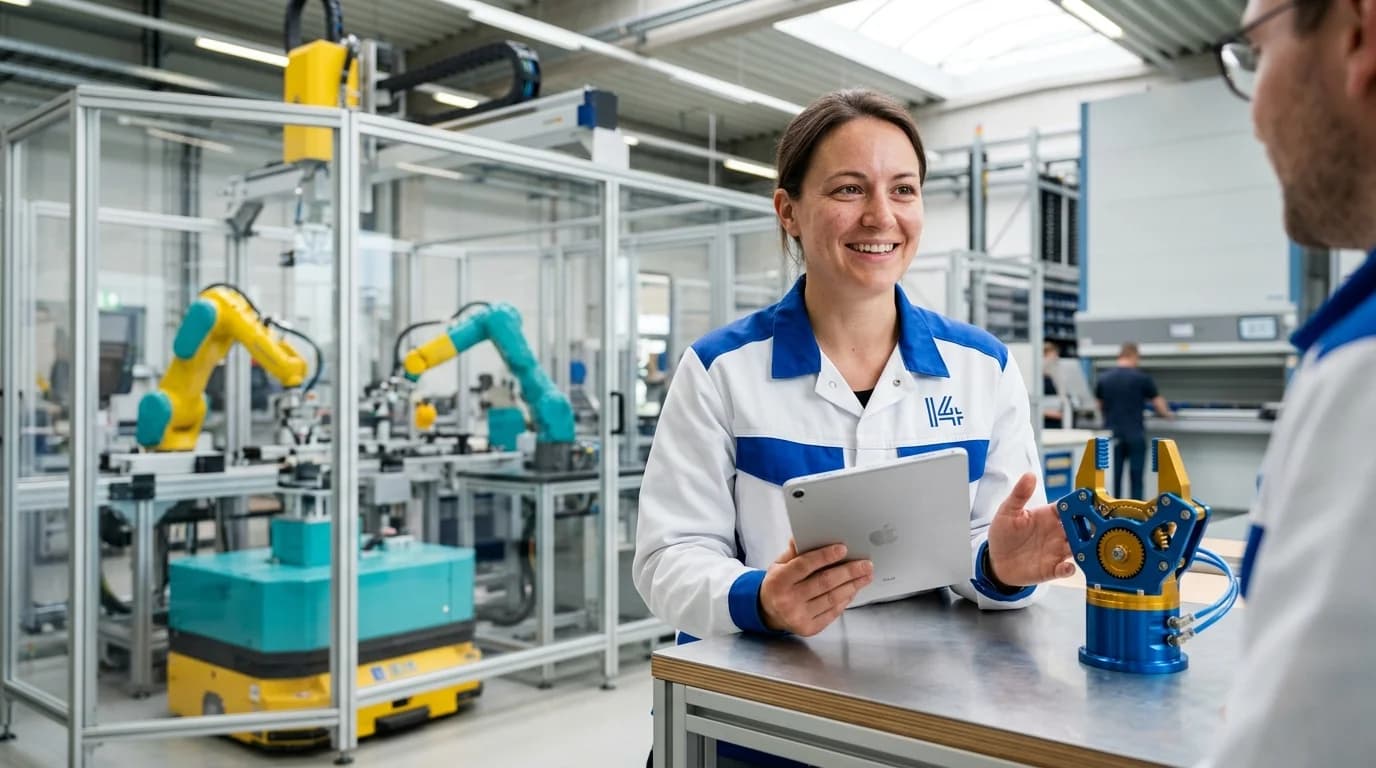
A smart factory is a plant where machines report their own state (running, stopped, fault, count) and production decisions are made from that data rather than from walking the floor. The machinery can be ordinary; what makes the factory smart is the connection between equipment, data, and the people deciding what happens next.
The term carries more sales weight than almost any other in manufacturing, so this guide stays concrete: what the label actually means, the layers a smart factory is built from, the software categories worth knowing, the obstacles every brownfield plant meets, and how a first project gets scoped so that it finishes.
The short version
- A smart factory is a plant where machines report their own state (running, stopped, fault, count) and production decisions follow that data instead of a walk around the floor.
- Automation and intelligence are independent: a robot-filled plant can be blind, while a mostly manual plant with honest machine data can qualify.
- Every working smart factory is built from four dependent layers: connectivity, a data platform, applications, and an intelligence layer on top.
- Industry 4.0 is the umbrella term; a smart factory is the concrete, plant-level piece you can scope, budget, and actually finish.
- The real obstacles are legacy machines, patchy data quality, and people trusting the system, not the choice of software.
- A realistic first project is one line, one use case, and eight to sixteen weeks to a before-and-after number that moves.
What makes a factory smart
The popular image is robot arms in a lights-out hall. That image confuses automation with intelligence, and the two are independent. A plant can be heavily automated and still dumb: robots executing fixed programs, blind to the jam two stations upstream, quality discovered at final inspection, downtime reconstructed from memory at the shift meeting. The robots are impressive, and the plant learns nothing from running them.
The reverse holds too. A modestly automated plant (manual assembly stations, a handful of CNC machines) can be genuinely smart: every machine state on record, scrap tied to its cause within the hour, a morning meeting that argues about what to fix instead of about what happened yesterday.
Strip away the vendor language and a smart factory does four things. It connects equipment so the machines can be heard. It collects what they say into one place, with timestamps and context attached. It decides from that record: what runs next, what gets maintained, what gets held for quality. And it acts quickly enough for the decision to change the current shift, not next month's report. Connect, collect, decide, act. Everything sold under the smart-factory banner is a piece of that loop, and the loop is the test: a technology that does not shorten the distance between something happening on the floor and somebody doing something about it is decoration.
The four layers
Working smart factories decompose into the same four-layer stack, whatever names the vendors used on the way in. Each layer depends on the one below it, which sets the build order more reliably than any roadmap slide.
Connectivity is the floor learning to talk. Newer machines speak OPC UA from the PLC, and MQTT has become the cheap common carrier for moving signals around a plant. Older machines need help: a current clamp in the electrical cabinet, a vibration sensor mounted on a magnet, a retrofit counter at the output chute. The deliverable at this layer is dull and decisive: a reliable stream of states, counts, and measurements from every machine that matters, including the ones that predate every protocol in the brochure. None of it requires replacing equipment, and most of it installs during a normal maintenance window.
The data platform is the plant's memory. The signals need somewhere to live: a time-series historian, increasingly a lakehouse, sometimes both. Architecture choices matter less than two disciplines. The first is one model: the same machine, product, and shift identified the same way everywhere, so the analytics and the maintenance system are not describing two different factories. The second is context: a temperature reading without the product, recipe, and machine state attached is a number, not a fact.
Applications are where the data starts paying. This is the layer a plant manager actually experiences. Execution software runs work orders and operator screens; what an MES does is its own subject. Analytics turn machine states into loss accounting, with OEE as the standard lens. Condition data feeds predictive maintenance software, which converts breakdowns into scheduled jobs. Planning tools read the same record to schedule against the plant that exists rather than the one described in the routing file. Each application is useful alone; on a shared data platform they compound, because each one consumes data the others produce.
Intelligence is the optional top floor. Machine learning earns its place here: anomaly detection on machine condition, scrap prediction from process parameters, schedule optimization under real constraints. It is also the most oversold layer, because models inherit everything beneath them. An anomaly detector fed by uncalibrated sensors detects miscalibration; a forecast trained on vague downtime codes forecasts the vagueness. AI in a factory is exactly as good as the three layers under it, which is why it belongs at the end of the build order rather than the beginning.
Smart manufacturing software: the categories that matter
A search for smart manufacturing software returns a wall of platforms whose names describe ambitions rather than functions. The way through is to map each product onto the four layers, because a layer is what every product actually is underneath.
Connectivity products, the layer most often sold as the Industrial Internet of Things (IIoT), get machines talking: protocol gateways, edge devices, retrofit sensor kits. Data products store and organize the stream: historians, unified-namespace brokers, industrial lakehouses. Application products do a job a manager can name: MES, OEE and downtime analytics, predictive maintenance, quality management, planning and scheduling. Intelligence products fit models to your data, or arrive pre-trained for standard classes of rotating equipment.
The label "smart manufacturing platform" usually re-badges one of these. Read past the positioning and the platform turns out to be a historian with dashboards, an MES with a marketing refresh, or an analytics suite with good connectors, sometimes an excellent one. Naming the layer cuts the evaluation down to size: a plant that already runs a historian does not need the one hiding inside the platform, and a plant with no connectivity will find the smartest analytics suite has nothing to analyze.
Three questions then sort any vendor meeting: what does it connect to, where does the data live and who owns it when the contract ends, and which decision on our floor does it improve. Products that survive all three are tools. The rest are slideware.
Industry 4.0, briefly
The term comes from a German government technology program, Industrie 4.0, presented at the Hannover trade fair in 2011; the numbering frames connected manufacturing as a fourth industrial era after steam, electricity, and computers. That is the entire history lesson a practitioner needs.
As a working concept it is too large to act on. Industry 4.0 covers the smart factory and everything around it: connected supply chains, digital twins, mass customization. That breadth suits policy papers and keynote titles, not a plant's quarterly plan. "Are we Industry 4.0 yet" has no answer. "Which of our four layers is weakest" always has one, and it usually points at connectivity or data quality, rarely at anything that fits on a conference slide.
The honest obstacles
Legacy machines come first because they are bolted to the floor. Brownfield is the normal case; greenfield plants designed smart from the slab are the exception that gets the keynote demos. A real machine park spans decades: a new five-axis cell shares a bay with a grinder that has outlived three ERP systems and communicates with none of them. The old machines are not a reason to wait. The retrofit toolbox is mature (clamps, sensors, even a camera reading the counter display in stubborn cases), and instrumenting a machine costs a small fraction of replacing it. What legacy equipment actually changes is the plan: connectivity must be surveyed machine by machine, and the survey belongs at the start of the project, because it is where budget estimates go to be corrected.
Data quality is the obstacle nobody budgets for. Three machines, three controllers, three opinions about what time it is: until clocks are synchronized, ordering events across a line is guesswork. Context goes missing, so a reading taken during a changeover gets averaged with one from steady production and the average means nothing. Units drift between systems: seconds in one, minutes in another, pieces counted against kilograms. None of this is difficult work, but all of it is long work, and skipping it is how a plant ends up with dashboards the floor stopped reading months ago.
People decide whether any of it sticks. An operator asked to trust a screen over their own eyes will test the screen, and the first time it is wrong, the experiment ends. Maintenance crews treat early predictive alerts the same way: open a healthy gearbox twice on a false alarm and the third alert goes unread. What works is involvement before rollout: operators help shape the screens, technicians record what they actually find when a machine comes apart, and the system earns trust by being right in small, checkable ways before anyone is asked to act on it sight unseen.
Scoping a first project
The standard failure mode of smart-factory initiatives is scope. A plant-wide program with a three-year horizon produces architecture documents; one line with one use case produces a number that moved.
The shape that works is one line, one use case, eight to sixteen weeks to production. Not a pilot (pilots are built to be abandoned politely) but a production deployment on a deliberately small surface: connect the machines on that line, land their data, stand up the single application the use case calls for (downtime tracking, OEE, condition monitoring on the bottleneck), and run it until the number it watches moves.
Picking the line matters more than picking the software, and three criteria do most of the work. Instrumentation already present: a line where most machines have usable PLCs starts weeks ahead of one that needs ten retrofits. A loss everyone already agrees on: the changeover the whole shift curses, the scrap rate with a nickname, the bottleneck of record. And an owner on the floor: a supervisor or process engineer who wants the system, chases its errors, and treats it as theirs rather than as something IT installed at them.
Measurable before expandable. The first project should end with a before-and-after figure (downtime found, OEE points recovered, changeover minutes returned) because that figure is the budget case for line two, and the obligation to produce it keeps everyone honest about scope. Expansion afterward is replication, and replication is cheap compared with invention.
Whether to run this with internal staff or an external team usually settles itself: the work spans PLC protocols, data engineering, and application development, and few plants keep all three skills on payroll at once. If the smart-factory conversation keeps ending at the slide deck, shrink it until it fits on one line of the floor. That is how our manufacturing software development practice scopes first projects: survey the machines, pick the loss, defer the platform debate, and produce a before-and-after figure within a quarter.
CTO and Co-founder at Idealogic. Directing engineering, systems architecture, security, and full-stack delivery across web, mobile, and blockchain.
Frequently asked questions
In simple terms, a smart factory is a plant where the equipment reports what it is doing and people decide from that record instead of from estimates and walked rounds. Machines publish their state (running, stopped, fault, counts) to a shared data layer; software turns that stream into schedules, alerts, and quality holds; and the loop closes fast enough to change the current shift rather than next month's report. The level of automation is beside the point: a plant full of robots can be blind, and a plant of manual stations with honest machine data can qualify.
Four layers of technology. Connectivity: OPC UA and MQTT for machines that can speak, retrofit sensors and current clamps for those that cannot. A data platform: a historian or lakehouse that stores the signals with timestamps and production context attached. Applications that act on the data: MES for execution, OEE and downtime analytics, predictive maintenance, planning and scheduling tools. And an intelligence layer on top (machine learning for anomaly detection, scrap prediction, and schedule optimization) which performs exactly as well as the data underneath it allows. Most plants build upward through this stack over years, not in a single program.
Industry 4.0 is the umbrella term; a smart factory is what one plant builds under it. The phrase comes from a German government initiative presented at the Hannover trade fair in 2011, which framed connected manufacturing as a fourth industrial era after steam, electricity, and computers. It spans everything from supply chain integration to digital twins. A smart factory is the concrete, plant-level piece: connected machines, a shared data layer, and software that turns the data into operating decisions. The practical difference is that a smart-factory project can be scoped, budgeted, and finished; nobody finishes Industry 4.0.
The drivers matter more than any quoted figure. Connectivity surface is the largest: how many machines, how old they are, and how many already speak a usable protocol versus needing retrofit sensors. Integration depth is next: whether the new layer must exchange data with the ERP, an existing MES, or a maintenance system, and in which direction. Then scope: a first project on one instrumented line, with one use case and a measurable target, lands materially below a plant-wide rollout. Any vendor who quotes a price before walking your floor and counting your protocols is pricing someone else's plant.
More from the journal

What Is a Transportation Management System (TMS)?
A transportation management system handles every step of moving freight: planning, rating, tendering, dispatch, and settlement. Here is how TMS software works, where it fits against a WMS, and when a custom build beats off-the-shelf.

Last-Mile Delivery Software: How It Is Built in 2026
Last-mile delivery software runs the loop from depot to door: dispatch, routing, a driver app, live tracking, proof of delivery and exceptions. How each part is built, what the measured economics say, what it costs to buy, and when building your own is the right call.

Fleet Management Software: How It Is Built in 2026
Fleet management software turns vehicle telematics into decisions about location, driving, cost and compliance. How it is built in 2026: the CAN bus to dashboard pipeline, ELD and tachograph rules as requirements, measured safety and fuel evidence, and the cost to buy or build.