LIMS Software in 2026: Architecture, Part 11 & Custom Build Cost
Engineering and 3-year TCO guide to LIMS software in 2026: LIMS vs LIS vs ELN vs SDMS boundaries, 96/384-well custody, ASTM/HL7/SiLA 2 analyzer interfacing, FDA 21 CFR Part 11, and custom vs legacy COTS cost.

On this page
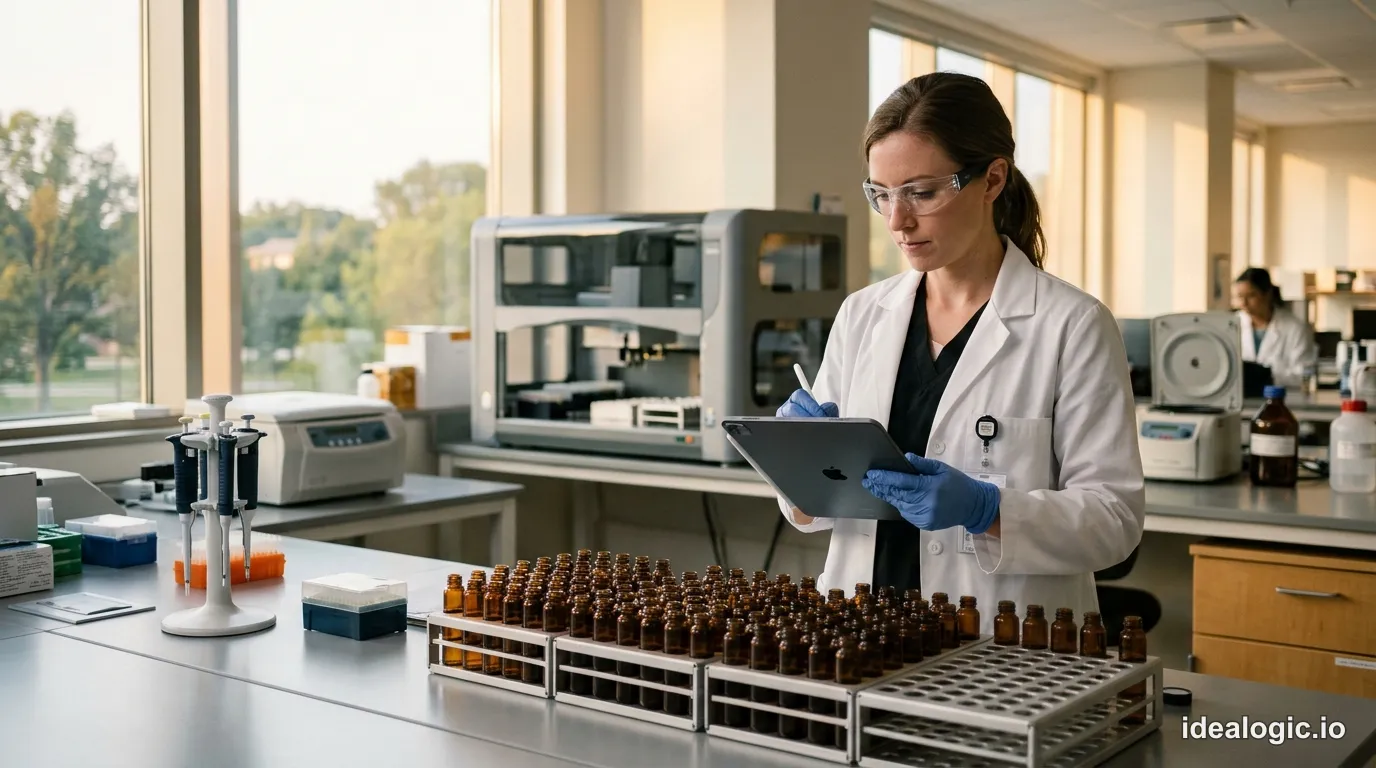
Every CTO, VP of Engineering, and Lab Director scoping LIMS software in 2026 hits the same procurement wall within thirty days. Legacy vendors (LabWare, STARLIMS, LabVantage) quote reasonable base licenses that triple once you add proprietary scripting consultants (LIMS Basic), per-instrument driver unlocks ($5,000 to $15,000 per analyzer), and nine-month validation schedules. Cloud R&D platforms (Benchling, enterprise SaaS suites) modernize scientist UX yet renew at $120,000 to $300,000+ per year once named seats, API rate tiers, and GMP modules kick in, while fighting custom robotics, multi-omics pooling, and external B2B ordering portals.
Postponing a laboratory information management system and running wet-lab operations across Excel workbooks and shared folders carries steeper risk. One transposed coordinate on a 384-well qPCR plate, an expired reagent lot on a clinical run, or a mutable row lacking a reason-for-change audit log can invalidate a manufacturing lot, trigger an FDA Warning Letter, or suspend a CMS CLIA certificate.
At Idealogic, our custom software development, healthtech, and manufacturing squads architect regulated clinical, biotech, and industrial traceability platforms with bidirectional HL7/FHIR pipelines and tamper-evident audit logs. Below is our 2026 benchmark covering LIMS vs LIS vs ELN vs SDMS boundaries, plate/custody state machines, ASTM / HL7 / SiLA 2 / OPC UA analyzer interfacing, FDA 21 CFR Part 11 + CSA validation, and 36-month TCO math.
The short version
- Separate the four lab informatics layers: LIMS governs sample custody, plate genealogy, reagent/calibration interlocks, Westgard QC, and
CoA/DiagnosticReportrelease; LIS handles patient clinical diagnostics andCPTbilling; ELN captures unstructured R&D notes; SDMS archives raw binary instrument outputs (HPLC,FASTQ, mass spectra). - Model custody and analyzers as deterministic state machines: Enforce parent-child aliquoting,
96/384-wellgeometry, reagent expiry locks, and LAN edge buffering (ASTM E1381/E1394,HL7 v2.5.1,OPC UA,SiLA 2) so WAN drops never stall bench scans or ZebraZPLprinting. - Design
21 CFR Part 11,CLIA, andISO 17025/15189into Migration #1: PostgreSQL append-onlyALCOA+audit chains, dual electronic signatures, and FDA Computer Software Assurance (CSA) automated tests avoid 3x to 4x post-launch retrofit bills. - 2026 custom LIMS cost vs 3-year COTS TCO: Discovery starts from $18,000 CEE (
$39,600 US), a specialty LIMS MVP runs $55,000 to $110,000 CEE ($121,000 to $242,000 US), and a multi-site21 CFR Part 11/CLIAbuild runs $115,000 to $240,000+ CEE ($253,000 to $528,000+ US). Across 60 seats and 12 analyzers over 36 months, an owned CEE build ($244,000 all-in) saves $148,000 vs enterprise SaaS ($392,000) and $242,000 vs legacy COTS ($486,000).
What LIMS software governs in 2026: LIMS vs LIS vs ELN vs SDMS
Failed laboratory RFPs routinely collapse four distinct systems under "LIMS." Draw hard boundaries around your primary entity, mutability profile, and regulatory mandate first:
- LIMS (Laboratory Information Management System): Sample-centric and specification-centric across pharma QA/QC, CROs,
NGSpipelines, water/soil testing, metallurgy, and food safety. Drives specimens and plates through rigid SOP state machines, enforces reagent/calibration locks, runs statistical QC, and releasesCoAsor structured diagnostic feeds. - LIS (Clinical Laboratory Information System): Patient-centric and order-centric for hospital core labs, anatomic pathology, and blood banks. Focuses on
ICD-10medical necessity,CPTbilling, slide/block grossing, and inpatientADT/OML/ORUsync with hospital EHRs (see EHR integration). - ELN (Electronic Lab Notebook): Experiment-centric for discovery R&D, medicinal chemistry, and synthetic biology (
CRISPRconstructs, stoichiometry, free-text notes, IP witness sign-offs). ELN schemas stay flexible because exploratory assays shift daily; LIMS schemas stay locked for validated execution. - SDMS (Scientific Data Management System): Archive-centric. Sweeps multi-gigabyte instrument files (
Waters Empower/Agilent OpenLabchromatograms, Orbitrap.rawspectra, IlluminaFASTQreads), normalizes headers into Allotrope Foundation Simple Model (ASM) JSON, and locks raw binaries in WORMAWS S3 Object Lockbuckets.
In a clean 2026 stack, PostgreSQL never stores 80 GB FASTQ blobs, and commercial batch release never runs inside a free-form ELN. Verified R&D methods graduate from the ELN into versioned AssayMethod definitions inside the LIMS; raw instrument runs stream into S3 Object Lock hashed by SHA-256; and the LIMS records quantitative peaks, QC flags, immutable URI pointers, and release signatures.
Sample chain-of-custody state machine & plate/rack topology
Toy schemas model a flat samples table with a status column. Wet labs break flat schemas immediately when one whole-blood tube splits into four plasma aliquots, three aliquots pool into well D07 of a 96-well plate alongside controls, one target fails a Westgard QC rule triggering a 1:10 dilution reflex run, and an inspector demands unbroken genealogy back to the collection kit lot.
1. Accessioning (DataMatrix / RFID) and parent-child DAG genealogy
Chain of custody starts at manifest creation. Clinics, field samplers, or plant lines register manifests digitally, generating 2D ECC 200 DataMatrix cryovial labels (readable despite 30% frost damage at -80 C), Code 128 tube barcodes, or HF/UHF RFID rack tags.
In PostgreSQL, genealogy lives in a Directed Acyclic Graph (DAG) connecting root specimens to lab_containers through an immutable container_lineage edge table (parent_container_id, child_container_id, transfer_volume_ul, pipetting_step_id, actor_id, created_at). Containers advance along guarded state transitions:
EXPECTED -> ACCESSIONED -> IN_STORAGE -> ALIQUOTED -> QUEUED_FOR_WORKLIST -> IN_ANALYZER -> RESULTED_RAW -> QC_VERIFIED -> RELEASED -> ARCHIVED / DISPOSED
If accessioning flags hemolysis, broken seals, or cold-chain excursions (> 8 C), a non-conformance gate locks the specimen in QUARANTINED_REJECTED, blocks worklist queuing, and opens an exception inside plant quality management software (QMS) or the clinician portal.
2. 96/384-well plate geometry, storage hierarchy, and reagent interlocks
High-throughput molecular, chromatography, and immunoassay benches run on spatial coordinates and hard pre-flight locks:
- Plate & biobank coordinate matrices: Containers map onto
PlateDefinitionlayouts (8x1296-well,16x24384-well,32x481536-well) enforcing(row_index, col_index)uniqueness plus control wells (A01Blank,A02Low QC,A03High QC,H12Calibrator). Freezer storage tracksFacility -> Freezer (-80C / LN2) -> Rack -> Box -> Slot (A1..J10)withfreeze_thaw_count <= max_allowed_cyclesguards. - Reagent lot & calibration interlocks: Under GMP and
ISO/IEC 17025, runs using expired master mix or overdue balances are invalid. Before advancing aRunBatchtoIN_ANALYZER, transactional locks checkreagent_lots(expiration_at > NOW() AND quarantine_flag = false) andinstruments(calibration_due_at > NOW() AND maintenance_lock = false).
3. Westgard QC rules, auto-verification, and CoA / FHIR R4 release
Guided by Clinical and Laboratory Standards Institute (CLSI) AUTO15 autoverification rules, the LIMS evaluates analyzer batches automatically:
- Westgard multi-rule QC: Control wells score against lot mean and
SD. Advisory1_2sflags warn analysts, while hard-stop rules (1_3sexceeding+-3 SD,2_2ssystematic shift, orR_4swithin-run range exceeding4 SD) quarantine the plate. - Dilution math & delta checks: Out-of-range linear readings auto-queue reflex dilutions, while clinical engines run longitudinal
Delta Checksagainst prior patient baselines to catch swapped tubes. - Outbound
CoA& FHIR R4 bundles: Industrial/pharma lots generate locked PDF/A Certificates of Analysis (CoAs) and release ERP/MES holds. Clinical platforms bind assays to LOINC observation codes (http://loinc.org) and UCUM units, emitting HL7 FHIR R4DiagnosticReportbundles referencingObservationand HL7 FHIR R4Specimengenealogy to EHRs or clinical trial management software (CTMS/EDC).
Bidirectional instrument & analyzer interfacing (ASTM, HL7 v2, OPC UA, SiLA 2)
Screens represent under 25% of LIMS engineering risk. The real moat is bidirectional analyzer interfacing: pushing worklists (Sample ID, Well, Assay Code, Dilution) to analyzers and ingesting raw results, flags, and reagent lot IDs without manual re-keying:
Hybrid cloud + local Docker edge gateway
Never port-forward lab VLANs to the internet or rely on WAN uptime to print labels. A stateless Dockerized Edge Gateway (TypeScript/Node.js or Rust) on redundant fanless IPCs inside each lab subnet drives Zebra ZPL II printers over TCP 9100 in < 80 ms, answers ASTM host-queries offline, buffers raw ASTM/HL7/HPLC payloads in local SQLite WAL before acknowledging analyzers, and syncs idempotently outbound over mTLS (HTTPS 443).
Production code: 21 CFR Part 11 append-only audit trail + e-signature binding
FDA 21 CFR Part 11 inspections test two controls immediately: immutable before/after audit chains with mandatory change reasons, and live credential re-verification permanently bound to signature meaning. Here is our production PostgreSQL 17 + TypeScript release pattern:
Regulatory & accreditation architecture (21 CFR Part 11, CSA, CLIA, ISO 17025 & 15189)
Regulators accredit validated laboratory operations, never unconfigured software binaries, yet missing database controls force QA staff back onto paper binders. Five regimes govern LIMS engineering in 2026:
- FDA
21 CFR Part 11&ALCOA+(GLP/GMP): Under FDA 21 CFR Part 11 and the FDA Data Integrity CGMP guidance, closed systems enforce ALCOA+ (Attributable, Legible, Contemporaneous, Original, Accurate, Complete, Consistent, Enduring, Available). Shared logins and SQLDELETEgrants are forbidden; server UTC timestamps,reason_for_changeprompts on peak re-integrations, and rendered signature manifestations (Name,UTC Time,Meaning) on screen and PDF outputs are mandatory. - FDA Computer Software Assurance (
CSA): Under the finalized FDA Computer Software Assurance guidance (finalized Sept 2025 and updated Feb 2026 for QMSR, paired with ISPE GAMP 5 2nd Edition in pharma GMP labs), risk-based verification replaces bloated manual screenshot binders (CSV). High-risk functions (Westgard QC quarantine, dilution math, CoA thresholds, Part 11 signatures) run automated Playwright/VitestIQ/OQsuites in CI/CD emitting signed traceability matrices per release, cutting validation overhead by 50%+. - CMS
CLIA(42 CFR Part 493): US human diagnostic labs under 42 CFR Part 493 retain requisitions, accession timestamps, calibration and two-level QC logs, critical-value read-back logs, amended report histories preserving prior values, and 2-to-10-year archives (2 yrsgeneral lab,10 yrsimmunohematology/transfusion per21 CFR 606.160(d)and pathology reports). ISO/IEC 17025&ISO 15189: Testing/calibration labs (ISO/IEC 17025:2017) and medical labs (ISO 15189:2022), recognized across the ILAC MRA framework, mandate NIST/SI metrological traceability, Measurement Uncertainty (MU) calculations near spec limits, and competency interlocks blocking operators with expired training from executing runs.- HIPAA
ePHI& Bench Blindness: Under 45 CFR Part 164 Subpart C, patient identifiers stay encrypted viaAWS KMS(AES-256) andTLS 1.3under cloudBAAs, while role-based views restrict wet-lab benches to pseudonymousAccession Barcode IDs(see HIPAA-compliant software development).
3-year TCO: Legacy COTS LIMS vs Enterprise SaaS vs Custom Cloud/Hybrid LIMS
Headline LIMS quotes hide per-seat expansion taxes, $250/hr proprietary scripting (LIMS Basic), and per-analyzer interface fees. Below is a worked 36-month TCO across 60 lab/QA seats, 12 analyzers, 21 CFR Part 11 / CLIA or ISO 17025 validation, and external B2B portals, comparing $75/hr Senior CEE vs $165/hr US Agency rates grounded in Eurostat ICT labor cost data (lc_lci_lev) and US BLS software developer wages:
Buy vs build vs strangle: Buy mid-market SaaS ($18k to $35k/yr) when a 15-seat lab runs standard EPA/USP methods with zero portal differentiation. Build custom when proprietary NGS pooling, robotics, or 500+ external clinician/sponsor users make named-seat pricing punitive. Or run a Hybrid Strangler ($40,000 to $85,000 CEE) via system integration and legacy system modernization, wrapping LabWare/STARLIMS behind a Next.js portal and Docker analyzer gateway.
2026 Custom LIMS software development cost matrix & effort breakdown
Every tier maps directly to Idealogic's custom software development cost benchmarks:
Inside the worked 2,000-hour ($150,000 CEE vs $330,000 US) regulated build
- 1. Custody DAG,
96/384-welltopology & Westgard QC (30% / 600 hrs / $45,000 CEE): Gloved barcode-wedge Next.js UI, PostgreSQL 17 lineage DAG, freezer coordinate slots, reagent/calibration interlocks, andCLSI AUTO15auto-verification. - 2. Docker edge gateway & 12 analyzer drivers (25% / 500 hrs / $37,500 CEE): SQLite WAL store-and-forward,
< 80 msZebraZPL IIprinting,ASTM E1381/E1394,HL7 v2.5.1MLLP, HPLCAllotropeparsers, andSiLA 2worklists. - 3.
21 CFR Part 11ledger, RBAC & dual e-signatures (20% / 400 hrs / $30,000 CEE): Hash-chained PostgreSQL triggers,reason_for_changemodals, SSO +WebAuthn/password signing challenges, segregation of duties, andHIPAAbench blindness. - 4.
CoAPDF/A engine, client portal & FHIR / ERP sync (15% / 300 hrs / $22,500 CEE): Manifest ordering portal, signedCoAgeneration,LOINCFHIR R4DiagnosticReport/Specimenbundles, and ERP quality holds via AI and system integration. - 5. Automated
CSAIQ/OQsuite & BAA cloud (10% / 200 hrs / $15,000 CEE): Terraform Multi-AZ RDS, S3 Object LockSDMSbuckets, and GitHub ActionsURS -> Testtraceability matrices.
A LIMS never fails because its management charts looked plain; it fails at 6:00 AM on the wet-lab bench when a Zebra cryovial label takes six seconds to print, a robotic plate map transposes column 12, or an auditor finds shared logins because signing took nine clicks. Build for the gloved technician holding a 2D scanner first, buffer every analyzer at the LAN edge, and lock Part 11 hash chains into Migration Number One.
Shipped Idealogic regulated traceability proof & CTO checklist
Idealogic ships these exact clinical interoperability, provenance, and cryptographic signature controls in live production:
- Bidirectional HL7 v2 & FHIR R4 clinical sync (AddMed): Live US healthcare pilots under HIPAA and GDPR with zero data incidents, pairing idempotent HL7 v2 and FHIR R4 clinical pipelines with durable retry queues.
- Tamper-evident part & lot genealogy (AirpartChain): AI/OCR document ingestion and cryptographic provenance across
AS9100aerospace supply chains, mirroring multi-tier specimen and reagent-lot traceability. - Qualified e-signatures &
SHA-256audit trails (Chaindoc): Shipped via SaaS development in 22 weeks, enforcing cryptographic signature binding across 10,000+ regulated agreements at 99.9% uptime.
Run five quick checks before signing a COTS contract or starting Sprint 1:
- Audit physical analyzer ports early: Document firmware, RS-232/TCP sockets,
ASTM/HL7specs, and watched folders during discovery. - Keep
SDMSblobs out of PostgreSQL: Store raw chromatograms andFASTQfiles in S3 Object Lock linked bySHA-256URIs. - Test gloved zero-mouse bench flows: Every routine tube and plate scan should finish with zero mouse clicks and
< 100 msZPLprinting. - Enforce
Part 11in SQL permissions:REVOKE UPDATE, DELETEon audit tables from the application role. - Automate
CSAIQ/OQin CI/CD: Emit signed test traceability matrices automatically so assay updates never stall in three-month validation freezes.
CTO and Co-founder at Idealogic. Directing engineering, systems architecture, security, and full-stack delivery across web, mobile, and blockchain.
Frequently asked questions
LIMS software (a laboratory information management system) is the operational database and workflow engine that governs physical samples, parent-child aliquots, 96-well and 384-well plate topologies, calibrated instruments, reagent lot expiries, quality control rules, and final Certificate of Analysis (CoA) or diagnostic report release. Unlike spreadsheets or generic ERP modules, a production LIMS enforces chain-of-custody state transitions and immutable audit trails from accessioning through disposal.
Each system owns a distinct layer of laboratory informatics. A LIMS governs sample-centric and batch-centric testing workflows across biotech, pharma QA/QC, environmental, food, and specialty molecular labs. A clinical LIS (Laboratory Information System) centers on individual patients, ICD-10/CPT medical billing, anatomic pathology, and hospital EHR orders. An ELN (Electronic Lab Notebook) captures unstructured R&D experiment protocols and scientist observations, while an SDMS (Scientific Data Management System) archives raw binary instrument files such as chromatography curves, mass spectra, and FASTQ reads.
With a senior Central and Eastern European (CEE) engineering squad billing $75 per hour, a 3 to 5 week LIMS workflow and instrument discovery sprint starts from $18,000 ($39,600 at $165 per hour in the US). A focused single-site specialty LIMS MVP with barcode custody, plate mapping, and initial analyzer parsing costs $55,000 to $110,000 in CEE ($121,000 to $242,000 US) over 10 to 16 weeks, while a multi-site FDA 21 CFR Part 11, CLIA, or ISO 17025 regulated LIMS with bidirectional analyzer middleware runs $115,000 to $240,000+ in CEE ($253,000 to $528,000+ US).
Buy a commercial off-the-shelf (COTS) LIMS when your laboratory runs standardized pharmacopeial QA/QC or routine testing where out-of-the-box templates match 85% of bench operations. Build a custom cloud or hybrid LIMS (or a custom orchestration portal and analyzer middleware layer) when proprietary assay pipelines, high-throughput NGS or multi-omics pooling, automated liquid-handler robotics, customer-facing B2B portals, or compounding per-seat enterprise SaaS renewals ($250 to $450+ per user per month) compress gross margins.
Laboratory instruments rarely speak modern REST JSON natively. Clinical chemistry, hematology, and immunoassay analyzers communicate over RS-232 serial ports or local TCP sockets using ASTM E1381/E1394 (CLSI LIS01/LIS02) frames or MLLP-wrapped HL7 v2.5.1 messages. Chromatography systems (HPLC, GC-MS) export watched CSV/XML folders or vendor SDK streams normalized into Allotrope Simple Model JSON, while modern liquid handlers and bioreactors increasingly expose gRPC-based SiLA 2 or industrial OPC UA interfaces via an edge agent.
Under FDA 21 CFR Part 11, a closed-system LIMS must enforce unique user identities, role-based access control, automatic session timeouts, and computer-generated, time-stamped, append-only audit trails that record the actor, UTC timestamp, prior value, new value, and mandatory reason for change without overwriting historical data. Electronic signatures on batch or result approvals must require credential re-authentication at the moment of signing and permanently bind the signer's printed name, timestamp, and explicit signature meaning (such as Reviewed or Released) to a cryptographic hash of the record.
Traditional Computer System Validation (CSV) often consumed 30% to 40% of project budgets by generating thousands of manual screenshot test scripts for low-risk UI screens. FDA Computer Software Assurance (CSA) shifts validation effort to critical thinking and risk-based testing: high-risk patient-safety or product-quality functions (such as Westgard QC blocking, dilution math, and Part 11 signatures) undergo rigorous scripted automated testing in CI/CD, while low-risk administrative features rely on unscripted exploratory testing and supplier assurance.
Yes. Production labs deploy a hybrid edge-to-cloud topology rather than exposing lab VLANs to the public internet. A lightweight Docker or Rust/Node.js edge gateway runs on an industrial mini-PC inside the laboratory subnet, polling local RS-232 serial adapters, ASTM/HL7 TCP sockets, watched HPLC directories, and Zebra ZPL label printers. The edge gateway buffers raw frames in local encrypted SQLite during internet outages and streams idempotent payloads outbound over mutual TLS (mTLS) to the cloud LIMS.
More from the journal
HL7 vs FHIR in 2026: Architecture, Payloads & Integration Cost
HL7 publishes both pipe-delimited HL7 v2 feeds and RESTful FHIR R4 APIs. Compare wire-level payloads, SMART on FHIR auth, ONC (g)(10) and CMS-0057-F mandates, and real $15k to $75k integration costs.
EHR Implementation Cost in 2026: SaaS Rollout vs Custom Build
Commercial EHR rollouts hide chart migration, HL7/FHIR interfaces, and clinician productivity loss behind per-seat quotes. Here is EHR implementation cost in 2026 across SaaS clinics, hospitals, SMART on FHIR sidecars, and custom specialty EHRs.

Telemedicine App Development Cost in 2026: Tiers & Vendor TCO
Pricing a telehealth app by screen count ignores clinical compliance. Here is telemedicine app development cost in 2026 across four build tiers, CEE vs US labor math, Surescripts and DEA EPCS onboarding fees, FHIR EHR sync, and monthly run-rate COGS.