Crypto Exchange Development Cost: Is It Worth It in 2026?
Thinking about launching a trading platform? Here's an honest look at what crypto exchange development costs in 2026: market saturation, CEX vs DEX, build vs white-label trade-offs, real budgets and timelines, and the regulatory burden you can't skip.

The original version of this question asked whether it was worth building an exchange back when Bitcoin first touched a trillion-dollar market cap. The math has changed since then, and so has the regulatory landscape. If you're weighing crypto exchange development cost in 2026, and whether building one is worth it at all, the honest answer is: it depends entirely on whether you have a real niche, a licensing plan, and a tolerance for compliance work that now rivals the engineering. This guide walks through the cost and the decision before the build, then sketches the build itself.
The short version
- Building a new crypto exchange in 2026 makes sense only with a genuine niche and a real licensing plan, because competing head-on with Binance or Coinbase as a generalist rarely works.
- A white-label launch can start in the tens of thousands of dollars plus monthly fees, while a custom centralized exchange with proper security and compliance usually runs from the low to mid six figures and higher.
- A centralized exchange (CEX) holds user funds and matches trades off-chain for speed and fiat support, while a decentralized exchange (DEX) settles on-chain with users keeping custody, trading lower legal risk for gas costs and smart-contract risk.
- Software is often the smaller line item, because security audits, licensing, and liquidity provisioning frequently rival or exceed the engineering budget.
- Most jurisdictions require you to register as a money services business, run KYC and AML, and comply with frameworks like MiCA and the FATF travel rule before launch.
- Most well-run teams take a hybrid path: they start from a proven exchange core and customize wallet security, compliance, and user experience where it matters.
Is it still worth building a crypto exchange?
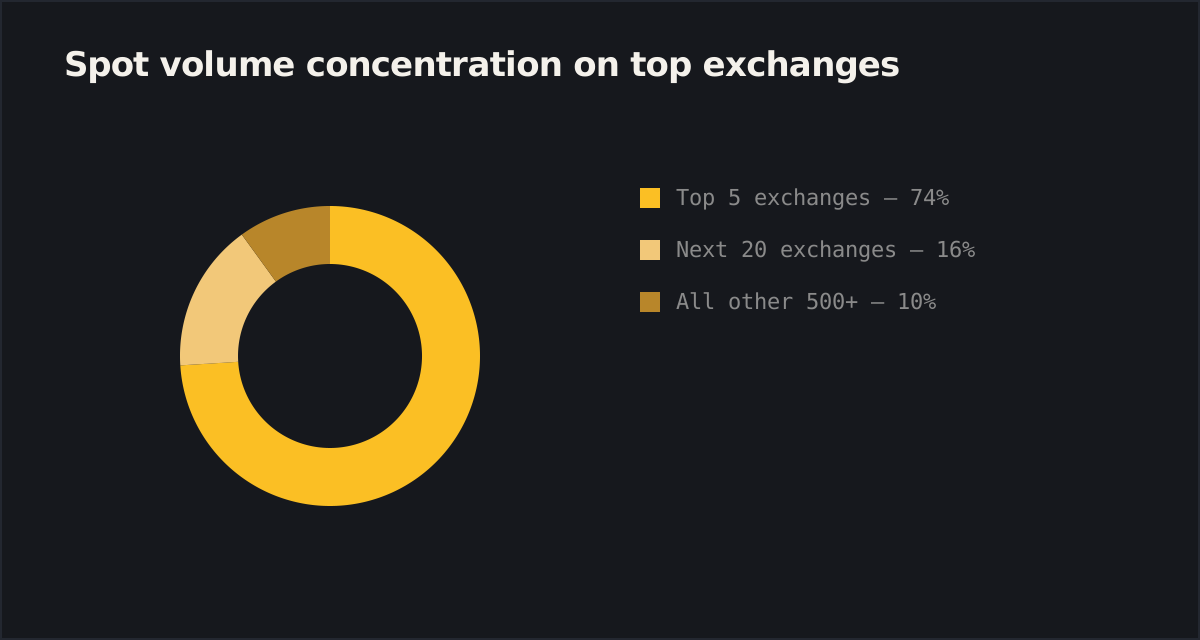
There are well over 500 active exchanges, and the top five handle the overwhelming majority of spot volume. Binance, Coinbase, Kraken, OKX, and a handful of others have the liquidity, the brand, and the regulatory licenses that took them a decade to assemble. Trying to beat them at their own game (a general-purpose exchange listing the same 300 tokens) is a way to burn capital fast.
That doesn't mean the market is closed. It means the open lanes are narrower and more specific than they were a few years ago. The teams that succeed now usually start from one of these positions:
- A captive audience. A fintech app, a neobank, a gaming platform, or a remittance business that already has users and wants to add trading or custody.
- A geographic or regulatory niche. A licensed exchange serving a region the majors have abandoned or never entered, often because compliance there is painful.
- An asset niche. Tokenized real-world assets, a specific derivatives product, or institutional-grade settlement that generalist venues handle poorly.
- A B2B angle. Selling exchange-as-infrastructure to other businesses rather than chasing retail traders directly.
If your only differentiator is "like Binance but newer," you don't have a business. You have a liquidity problem waiting to happen.
The hardest part of running an exchange isn't the matching engine. It's liquidity. An order book with no depth gives traders terrible fills, and traders leave for venues where they can actually execute. New exchanges solve this with market-maker agreements, liquidity aggregation from larger venues, or by launching as a DEX where automated market makers provide depth algorithmically. Plan for liquidity before you write a line of backend code.
CEX vs DEX: which model fits your plan?
The choice between a centralized and a decentralized exchange shapes everything downstream: your tech stack, your custody model, your compliance obligations, and your cost structure.
Centralized exchanges
A CEX holds user funds, runs an off-chain order book and matching engine, and settles trades internally. This is the Coinbase or Kraken model. Users get fast execution, fiat on-ramps, customer support, and a familiar interface. You get custody risk, a large attack surface, and the full weight of financial regulation, because holding customer money makes you a regulated custodian almost everywhere.
CEX strengths:
- Fast, deterministic order matching with deep order-book features
- Fiat integration, card payments, and easier onboarding for non-crypto users
- Full control over the product experience
CEX burdens: you are responsible for securing every dollar and every private key, and a single breach can end the company.
Decentralized exchanges
A DEX settles trades on-chain through smart contracts. Users keep custody of their own funds and connect a self-custody or smart-contract wallet to trade. Uniswap-style automated market makers replaced the order book with liquidity pools, which solved the cold-start liquidity problem for long-tail tokens.
DEX strengths:
- No custody of user funds, which removes a large category of legal and security risk
- Permissionless listing and composability with the broader DeFi ecosystem
- Lower operational headcount once contracts are audited and deployed
DEX burdens: on-chain settlement is slower and costs gas, fiat on-ramps require third parties, smart-contract bugs are catastrophic and public, and the regulatory status of running front-ends is increasingly contested rather than clearly safe.
Hybrid models
Hybrid designs try to keep the speed of off-chain matching with on-chain or non-custodial settlement. They're technically harder to build and harder to explain to users, but they suit institutional products where both performance and custody guarantees matter. Most first-time builders should pick a clean CEX or DEX and avoid the hybrid complexity until there's a concrete reason for it.
Build vs white-label: the real fork in the road
This is the decision that determines your timeline and most of your budget. There are three realistic paths. The budget column below is deliberately given as ranges rather than point figures, because nobody publishes exchange build prices and any single number you see quoted is somebody's guess dressed up as a benchmark.
| Path | Time to launch | Starting budget | You control | Best when |
|---|---|---|---|---|
| White-label | Weeks to a few months | Tens of thousands, plus monthly fees | Branding and config only | You need to test a market fast and technology isn't your edge |
| Hybrid | A few months and up | Between the two, scaling with customization | Wallet security, compliance, and UX | You want a proven core but own the parts that matter |
| Custom | Several months to over a year | Low-to-mid six figures and up | The whole stack | The platform itself is your differentiator |
White-label. You license a ready-made exchange platform and rebrand it. Time to launch can be weeks to a few months. You give up control over the codebase, pay ongoing licensing fees, and inherit whatever the vendor's architecture and security posture happen to be. Good for testing a market quickly; bad if your differentiator is the technology itself.
Custom build. You build the matching engine, wallet infrastructure, admin tooling, and compliance stack from the ground up, or assemble them from vetted open-source components. This is where an experienced blockchain development team earns its fee. The difference between a toy and a system that survives an adversarial environment is in the details of key management, transaction signing, and failure handling. Timelines run from several months to over a year for a serious platform.
Hybrid build. Start from a solid open-source or licensed core, then customize the parts that matter to your niche. This is what most well-run projects actually do. You don't reinvent a matching engine, but you do own your wallet security, your compliance integrations, and your user experience.
The cost gap is large. A white-label launch might run from tens of thousands of dollars plus monthly fees. A custom CEX with proper security, custody, and compliance work commonly lands somewhere in the low-to-mid six figures and can climb well past that once licensing, audits, and liquidity provisioning are included. Anyone quoting you a flat "exchange for $15k" is selling a demo, not a business.
What drives crypto exchange development cost
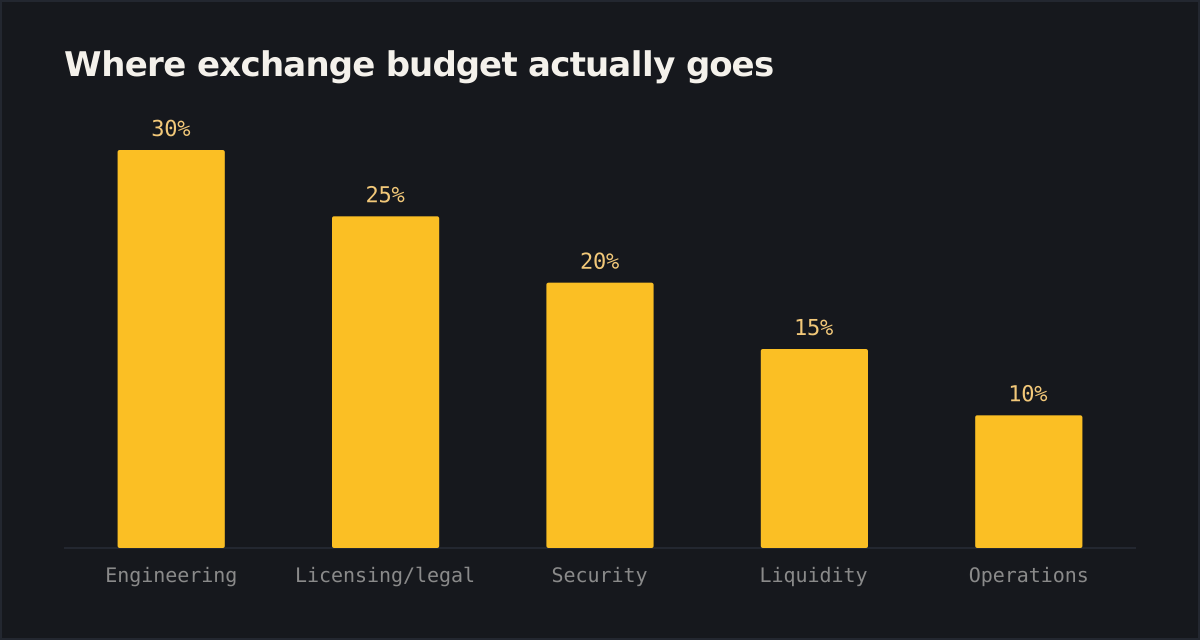
When people ask about crypto exchange cost, they usually picture the software. The software is often the smaller line item. Budget across all of these:
- Engineering. Matching engine or AMM contracts, wallet and custody layer, APIs, admin panel, and front-end.
- Security. Smart-contract audits, penetration testing, key-management infrastructure (HSMs or MPC), and ongoing monitoring. Skipping this is how exchanges get drained.
- Licensing and legal. Registration, legal opinions, and the compliance program itself. In many jurisdictions this rivals or exceeds the build cost.
- Liquidity. Market-maker fees, inventory, or capital seeded into AMM pools.
- Operations. Fiat banking relationships, customer support, fraud monitoring, and incident response (recurring costs that never stop).
If you want a deeper breakdown of where the money goes and how exchanges actually make it back, our piece on core exchange features and income generation covers the revenue side in detail.
The regulatory burden you can't skip
Compliance has gone from a footnote to a gating factor. The European Union's MiCA framework now licenses crypto firms as crypto-asset service providers (CASPs) and sets reporting requirements across member states. The Financial Action Task Force's travel rule obliges exchanges to share originator and beneficiary information on transfers above set thresholds. Most jurisdictions require you to register as a virtual asset service provider (VASP) or money services business and run a full KYC and AML program.
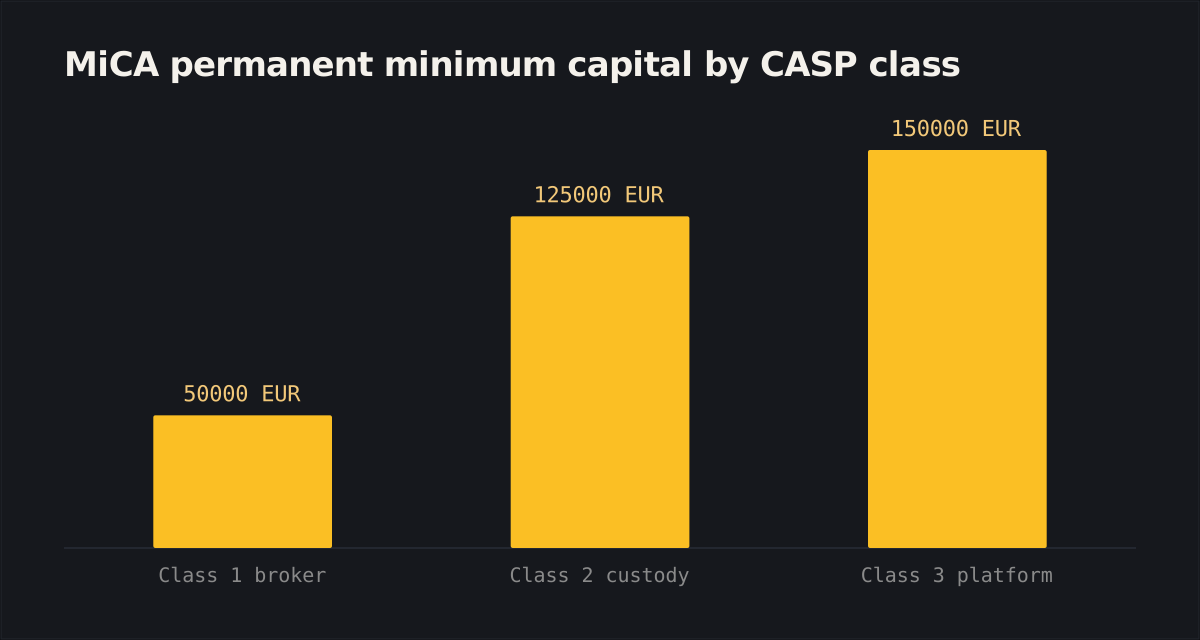
MiCA is also one of the few places in this whole exercise where a hard number is written down. Annex IV of Regulation (EU) 2023/1114 sets permanent minimum capital by class: EUR 50,000 for a class 1 provider that executes, places, transmits orders or advises; EUR 125,000 once you add custody or exchange of crypto for funds; and EUR 150,000 for a class 3 provider that operates a trading platform, which is what most people mean when they say exchange. Article 67(1) then requires prudential safeguards equal to the higher of that floor or one quarter of the previous year's fixed overheads, so the requirement grows with the business rather than sitting still.
Do not read those figures as the cost of getting licensed. They are capital you must hold, and they are the smallest part of the exercise. The legal opinions, the compliance hires, the monitoring vendors, and the audits are what actually drain the budget, and none of them publish a price list.
Practically, that means before launch you need:
- A jurisdiction chosen on purpose, with a registration or license path you've actually scoped
- KYC and identity verification wired into onboarding
- AML transaction monitoring and sanctions screening
- The travel-rule data exchange with counterparty venues
- Clear custody and segregation-of-funds policies, audited
A custodial CEX carries the heaviest version of all of this. A non-custodial DEX reduces some obligations but does not make them disappear, and the rules around front-ends are tightening rather than relaxing. Treat legal counsel as a first-week hire, not a launch-week scramble.
How to build a crypto exchange: a high-level outline
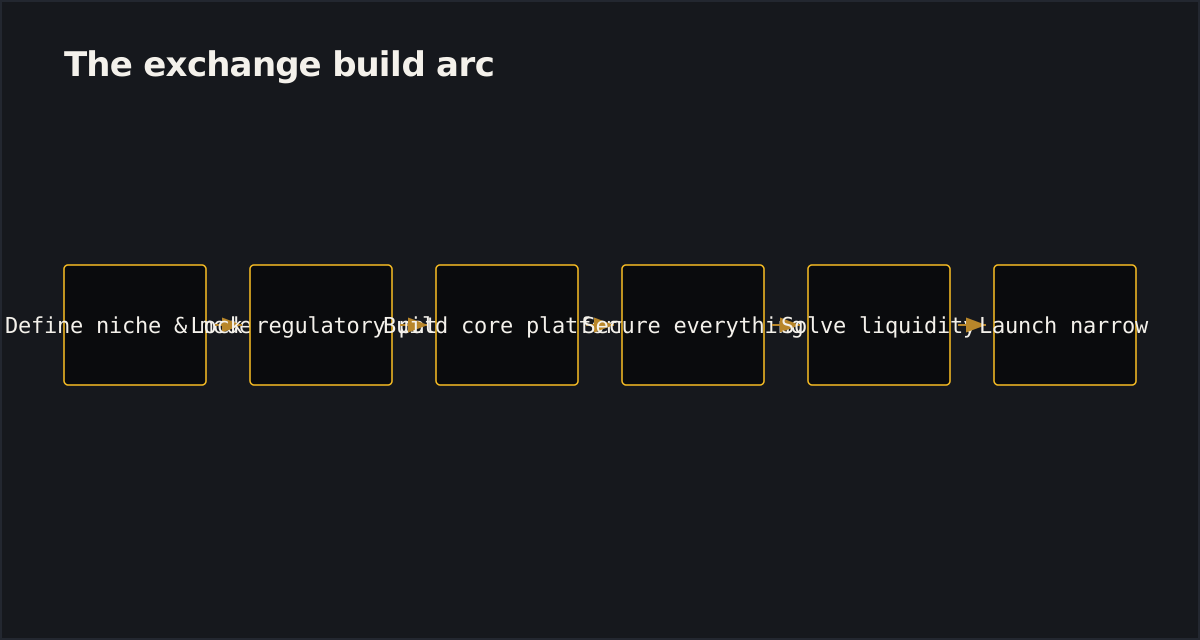
Once the decision work is done, the build follows a recognizable arc. This is the outline, not a substitute for a real architecture spec.
1. Define the niche and model
Pick CEX, DEX, or hybrid. Name the audience and the one thing you do better than the majors. Decide custody posture, because it drives everything after it.
2. Lock the regulatory path
Choose your jurisdiction and licensing route with counsel before building. Design KYC, AML, and travel-rule compliance into the product from day one rather than bolting it on later.
3. Build the core platform
For a CEX, that's the matching engine, order book, the wallet and custody layer, fiat on-ramps, and the trading APIs. For a DEX, it's audited smart contracts, liquidity-pool design, and a clean front-end against a node infrastructure. Either way, the wallet and key-management layer is the heart of the system. Understanding the different wallet architectures is foundational before you commit.
4. Secure everything
Independent smart-contract audits, penetration testing, HSM or MPC key management, rate limiting, and withdrawal controls. Security is not a phase you finish; it's a standing function.
5. Solve liquidity
Sign market makers, aggregate liquidity from larger venues, or seed AMM pools. An exchange with thin books fails regardless of how clean the code is.
6. Launch narrow, then expand
Open with a small set of trading pairs, a tested compliance flow, and real monitoring. Add markets, features, and jurisdictions once the core is proven under live load.
Building an exchange in 2026 is a serious undertaking, closer to launching a regulated financial institution than shipping an app. It's worth doing when you have a genuine niche, a licensing plan, and a partner who has built custody and trading systems before. It's a costly mistake when it's just an attempt to copy the incumbents.
Frequently asked questions
A white-label launch can start in the tens of thousands of dollars plus monthly licensing fees. A custom centralized exchange with proper security, custody, and compliance typically runs from the low to mid six figures, and more once audits, licensing, and liquidity provisioning are included. Software is often the smaller part of the total.
White-label platforms can launch in a few weeks to a few months. A custom build with a real matching engine, secure wallet infrastructure, and a full compliance stack usually takes several months to over a year, depending on whether you're building a CEX, a DEX, and how complex your regulatory path is.
It's worth it if you have a specific niche, a captive audience, or a B2B angle, plus a real licensing plan. Competing head-on with Binance or Coinbase as a generalist exchange rarely works because of liquidity and brand barriers. The teams that succeed solve a problem the incumbents ignore.
A centralized exchange (CEX) holds user funds and matches trades off-chain, giving fast execution and fiat support but carrying custody risk and heavy regulation. A decentralized exchange (DEX) settles on-chain through smart contracts with users keeping custody, which lowers some legal risk but adds gas costs and smart-contract risk.
In most jurisdictions, yes. Custodial exchanges typically must register as a money services business or obtain a license, run KYC and AML programs, and comply with frameworks like MiCA in the EU and the FATF travel rule. Choose your jurisdiction and licensing path with legal counsel before you start building.
Use white-label to test a market quickly when technology isn't your differentiator; you trade control and ongoing fees for speed. Build custom when your edge is the platform itself or you need full control over security and compliance. Many teams take a hybrid path: a proven core, customized where it matters.
More from the journal

What Is Cryptocurrency? A Beginner's Guide to How It Works
Cryptocurrency is digital money that runs on a blockchain, not a bank. This guide explains what crypto is, how it works, the main types like Bitcoin, Ethereum, and stablecoins, how to buy and store it safely, and the risks, scams, and tax basics worth knowing first.

Cryptocurrency Exchange Development: Features and Revenue
What actually goes into cryptocurrency exchange development, from the matching engine and custody to KYC/AML and liquidity, and the real revenue models behind fees, spreads, listings, and staking.