What Is DeFi? How Decentralized Finance Works in 2026
A measured answer to what DeFi is and how it works: smart contracts, liquidity pools and the constant product formula, lending and liquidations, stablecoins, oracles, where the yield comes from, what has actually been drained, and where the rules stood in September 2026.

The short answer to what is DeFi: financial services rebuilt as programs on a public blockchain, so lending, trading and saving run through code that holds the money instead of a company that holds it for you. Everything below follows from that one substitution.
We build these systems, so this is a briefing rather than a pitch. Every number is measured and dated, disagreeing sources appear side by side, and anything still unsettled in September 2026 says so.
The short version
- DeFi replaces the institution in the middle with smart contracts that custody funds and execute published rules, which shifts both the control and the responsibility onto you.
- DeFiLlama measured $87.5 billion locked across DeFi on 10 September 2026, inside a 2026 range of $68.4 billion to $127.5 billion and well below the November 2021 peak of $177.5 billion.
- Trades price off a constant product formula,
x * y = k, which is why a large trade against a thin pool gets a bad price and why liquidity depth is the thing to check first. - Lending is over-collateralised and liquidated by code, because a contract cannot sue you.
- Yield comes from trading fees, borrowing demand, staking rewards and token incentives. On 10 September 2026 that meant roughly 2.33% on staked ETH and 3.71% on supplied USDC, against a 13-week US Treasury bill at 3.90%.
- Across 301 DeFi protocol incidents in 2025 and 2026 to date, DeFiLlama attributes $1.91 billion in losses mostly to accounting bugs, broken access control and cross-chain messaging, not to the blockchain itself.
What is DeFi
DeFi, short for decentralized finance, is the practice of running financial services directly on a public blockchain through smart contracts, with no bank, broker or clearing house holding the assets or approving the transaction. Ethereum's own documentation frames it as a collective term for financial products and services accessible to anyone who can use Ethereum, which is the honest version: the defining feature is who can reach it and who holds it, not any particular yield.
Four properties do most of the work, and each has a cost attached.
- Non-custodial. Your assets sit in a wallet you control. No institution can freeze them, and none can recover them for you.
- Permissionless. No application form, and no compliance desk checking who sits on the other side of the pool.
- Everything is public: balances, transactions, contract bytecode. So are the bugs.
- Contracts compose. They call each other inside one transaction, which is why the ecosystem ships fast and why one failure spreads.
Scale is worth stating plainly, since the category gets called either enormous or dead. DeFiLlama put total value locked at $87.5 billion on 10 September 2026, against $310.9 billion of dollar-pegged stablecoins in circulation the same day, most of which never touches a protocol. The access argument is the sharper one, and it is smaller than people usually make it: the World Bank's Global Findex 2025 puts 79% of adults worldwide on a financial account, leaving about one in five outside. An earlier version of this article claimed a far larger exclusion figure. It was wrong, and it's gone.
What is a smart contract
A smart contract is a program deployed to an address on a blockchain. Ethereum's documentation defines it as "a collection of code (its functions) and data (its state) that resides at a specific address on the Ethereum blockchain". It holds a token balance like any account, exposes functions anyone can call, and executes identically on every node.
Three consequences follow, and they explain most of what feels strange about DeFi.
First, determinism. Given the same inputs and chain state, the contract returns the same result on every node, which is how thousands of machines agree without a referee.
Second, permanence. The same documentation notes that smart contracts "cannot be deleted by default, and interactions with them are irreversible." A deployed bug is not a support ticket. It is a standing liability in public view next to the funds it guards, which is why teams shipping contracts that hold real money treat review and adversarial testing as the work rather than the polish. Our write-up on DeFi smart contract development covers that discipline.
Third, openness. Contracts are public and, as Ethereum puts it, "can be thought of as open APIs." Nobody signs an integration agreement to build on Aave, which is what makes the rest of this article possible.
How DeFi works, mechanically
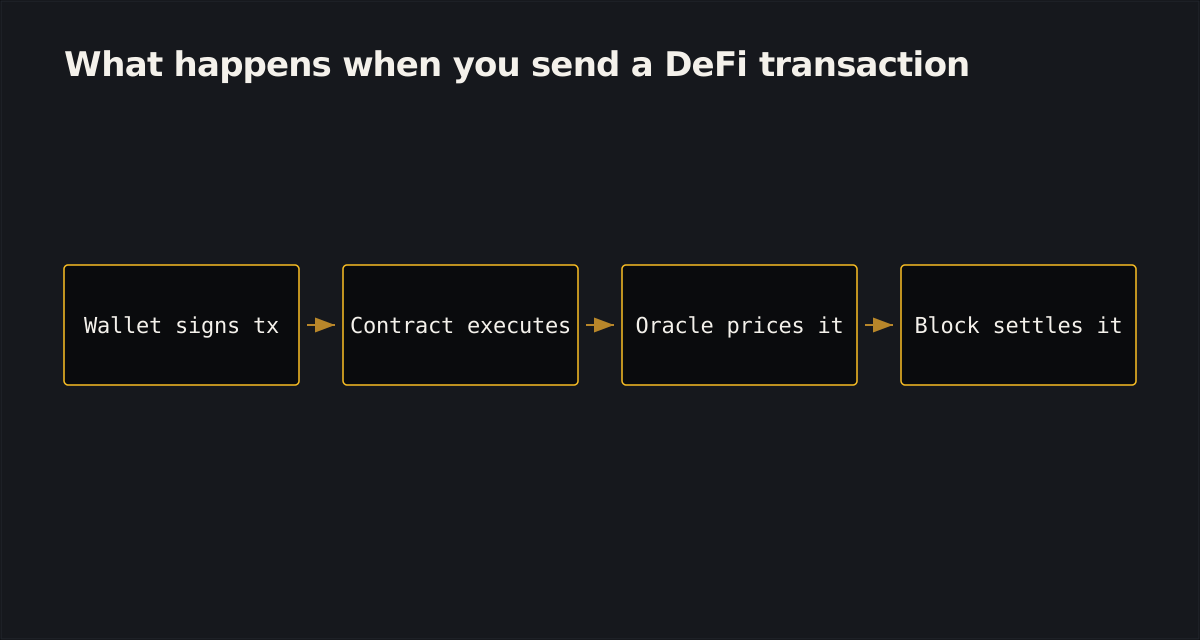
A DeFi transaction is a signed message asking a contract to do something. Your wallet signs with a private key, the network broadcasts it, the contract executes, and a block finalises every state change at once. If any step fails, the whole sequence reverts and you pay only the gas. No pending queue, no overnight batch.
Wallets and keys are the actual account
Your wallet is a key pair, not a balance. The chain stores balances against addresses; the wallet stores the private key that can move them. Lose the key and the funds stay visible on-chain forever and unreachable. Key handling, not protocol choice, is where most individual losses start, which is why the custody tradeoffs in our guide to types of digital wallets are worth reading before you move anything.
Liquidity pools and the constant product formula
A liquidity pool is a contract holding reserves of two tokens that traders trade against instead of waiting for a counterparty. Providers deposit both sides and take a claim on the pool plus a share of the fees. An automated market maker prices the trade instead of an order book, and the canonical rule is the constant product formula Uniswap's documentation states directly:
x * y = k
Here x and y are the two reserve balances and k is an invariant that must stay constant or increase after every trade. Nobody quotes a price. It falls out of the ratio.
Worked example, assumptions stated. Take a pool with 100 ETH and 300,000 USDC, so k is 30,000,000 and spot is 3,000 USDC per ETH. Apply the flat 0.30% fee Uniswap v2 charges on every pool. Sell 1 ETH and 0.997 reaches the reserves, the new USDC reserve is 30,000,000 divided by 100.997, and you receive 2,961.47 USDC: 1.28% below spot, of which 0.30% is fee and the rest is price impact. Sell 10 ETH and you get 27,198.33 USDC, an effective 2,719.83 per ETH, 9.34% below spot. Sell 25 ETH and the gap reaches 20.19%.
None of that is a market opinion. It's arithmetic on the invariant, and it's the one thing worth internalising about DEX pricing: your cost is set by your size relative to the pool, not by a spread someone posts. Newer designs change the shape, not the principle. Concentrated liquidity applies the same formula inside a chosen price band, and the fee is now a parameter: v3 added 0.05%, 0.30% and 1% tiers, and v4 lets a pool creator set any fee from 0% to 100%. Uniswap governance switched protocol fees on across all v2 pools in December 2025, taking roughly a sixth of the swap fee.
DeFi lending: over-collateralisation and liquidation
A DeFi lending market is a pool of deposits that borrowers draw against after posting collateral worth more than the loan. Over-collateralisation is structural rather than cautious: the contract cannot identify you or sue you, so holding more of your money than you took is the only enforcement it has.
Rates float with utilisation, the share of the pool currently lent out. Aave's interest rate strategy uses two slopes around an optimal usage ratio: gentle below it, steep above. The steep part protects withdrawals: suppliers can only exit while some of the pool sits unlent, so the protocol makes that last slice expensive enough to push borrowers into repaying.
Liquidation is the other half. Aave's Pool documentation describes liquidationCall as the function to liquidate a position with a health factor below 1, caps each call at 50% of the debt through a close factor of 0.5, and pays the liquidator a bonus on the seized collateral. No warning letter, no grace period: a price move and a bot are the entire process. Borrow near the limit on volatile collateral and you're one candle away from paying that bonus to a stranger.
Stablecoins, sorted by what actually backs them
Stablecoins are the settlement asset that makes the rest usable, and the only classification that matters is what stands behind the peg. DeFiLlama's stablecoin data on 10 September 2026 puts $310.9 billion in circulation, split 91.6% fiat-backed, 8.3% crypto-backed and 0.1% algorithmic.
That 0.1% is the market's verdict on the third model, not ours. Algorithmic pegs aren't illegal or impossible, they just keep failing. USDT at $183.4 billion and USDC at $74.3 billion carry most of the supply, with Sky's USDS at $6.7 billion and the older DAI at $4.8 billion leading the crypto-backed side.
Oracles bring the outside world in
A blockchain cannot see an exchange price on its own, and that isolation is deliberate: it is what keeps execution deterministic. An oracle writes an external number on-chain in a form contracts can read, which is how a lending market knows whether your position is still healthy.
That makes the oracle the most consequential component in the stack, because the contract trusts whatever number it reads. Distort the price briefly and you can borrow against collateral the protocol has misvalued, or fire liquidations that should not have triggered. Time-weighted averages, multiple independent feeds and aggregation all exist because of that one attack.
Composability, and the price of it
Contracts can call other contracts inside a single atomic transaction. One transaction can borrow, swap, redeposit and pledge the result elsewhere, and it either completes in full or unwinds entirely. Flash loans exist purely because of this: repayment has to land before the transaction ends, or the borrow itself reverts.
The cost is correlation. When protocol B builds on protocol A, a bug or a depeg in A arrives at B unannounced, and at everything above B after that. You get the capital efficiency and the contagion from the same mechanism, which is worth remembering before you add a fourth integration.
The DeFi protocols behind each building block
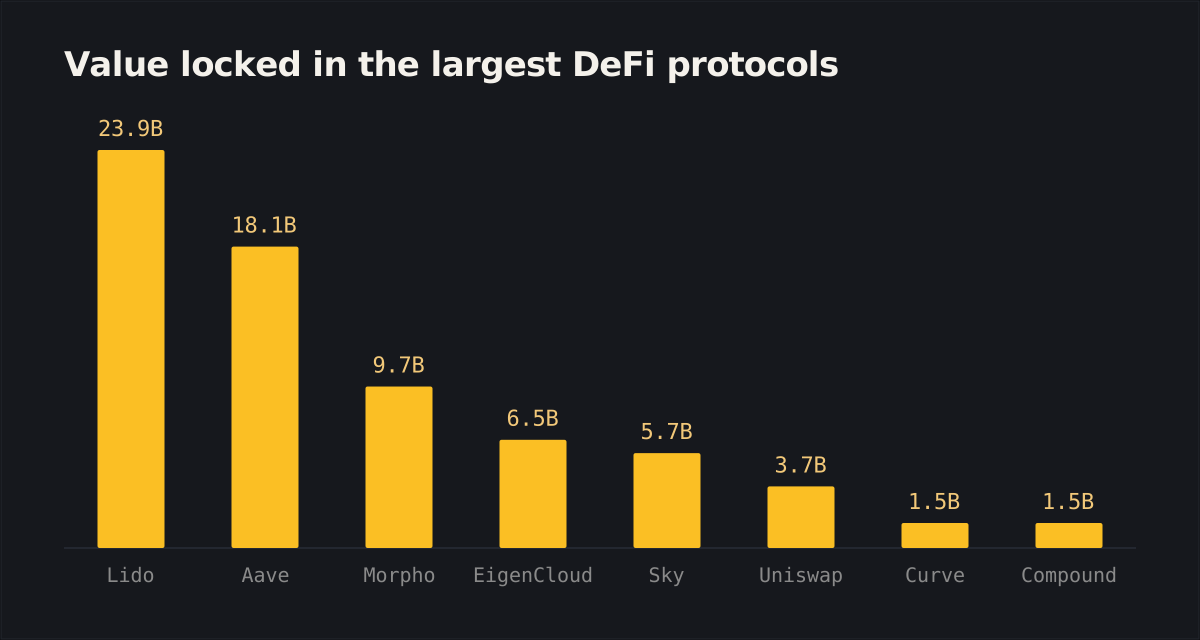
Each building block above has a handful of protocols carrying most of its volume. All eight below were operating and holding deposits when we read DeFiLlama on 10 September 2026, worth stating because explainers written in 2021 still name protocols that are gone.
Uniswap is the reason to distrust a pure TVL ranking. It sits sixth here and first by a wide margin on volume, because an AMM turns its capital over constantly while a staking protocol parks it. Read the metric that matches the job. For the full taxonomy, including derivatives, bridges and the oracle and aggregator layers that hold almost no TVL yet sit upstream of everything, see our breakdown of DeFi protocols and their types.
DeFi vs CeFi vs traditional finance
The three models are separated by custody, and every other difference follows from it.
None of the three wins outright. CeFi is the model most people actually use, and its failures have cost the most: DeFiLlama's hack database records $6.24 billion lost across 116 centralised exchange incidents, including the largest single theft of 2025. That side of the market has its own mechanics, which we cover in our guide to crypto exchange features and revenue models.
Custody is the whole argument. In DeFi you hold the keys, which means you also hold the recovery problem when something goes wrong.
Where DeFi yield actually comes from
Four sources produce almost all DeFi yield, and any advertised rate is a mixture of them. Work out the mixture before you look at the number.
Rates measured on DeFiLlama Yields, 10 September 2026. A fifth source has grown alongside these: tokenised treasury and basis-trade products pass through a return earned off-chain, which is a different risk to price.
Put those against the risk-free alternative. On 9 September 2026 the US Treasury's daily bill rates put the 13-week bill at a 3.90% coupon equivalent. Supplying USDC to the largest lending market on Ethereum paid 3.71%, so stablecoin lending in DeFi was paying below a Treasury bill while carrying contract, oracle and depeg risk on top. That's not an argument against DeFi. It's an argument for knowing what you're being paid for.
APR against APY, with the arithmetic
APR is the simple annualised rate. APY assumes you harvest and redeposit on a schedule, so compounding inflates the headline. The formula is (1 + APR/n)^n - 1 for n periods. The gap is trivial at ordinary rates and absurd at advertised ones.
Worked example, compounding assumed to happen on schedule with no gas cost and no change in the reward token's price.
Both assumptions are usually false, and that's where the advertised number goes to die. Harvesting costs gas, which can exceed the reward on a small position, and an emission-heavy APY is quoted as though the token you receive holds today's price while the emissions push it down. A four-figure APY is a compounding artifact attached to a decaying asset.
Yield farming and liquidity mining
Yield farming is moving capital between protocols to capture those four return sources. Liquidity mining is one method inside it: supply a pool, take the LP tokens, stake them in a second contract that pays the protocol's own token on top of the trading fees. Fee income and emissions stack, which is where the eye-watering numbers come from, and you now hold three assets instead of two, each shaped by its own token supply and vesting schedule.
What liquidity mining really does is rent deposits. A protocol that needs liquidity before it has volume pays for it in equity. Useful as a bootstrapping tool, dangerous to mistake for a savings rate.
Impermanent loss, with the formula
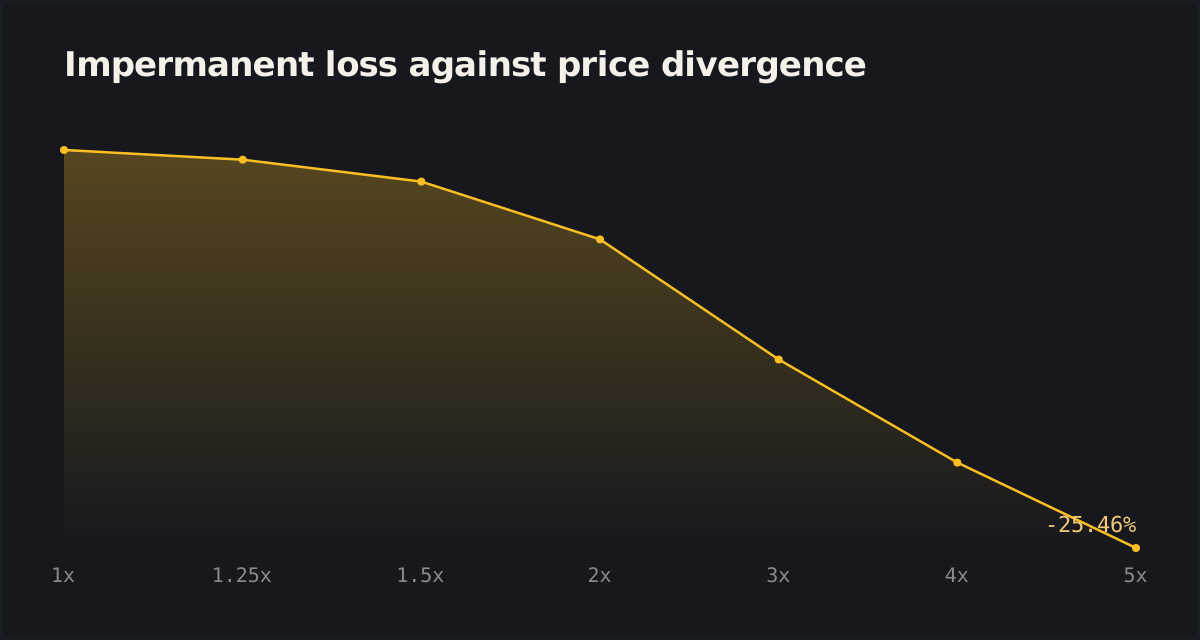
Impermanent loss is the gap between holding two tokens and supplying them to a pool once their prices move apart. Nobody charges it. It falls out of the same invariant that prices the trades: as one asset rises, arbitrageurs buy it out of the pool and leave you holding more of the one that fell.
For a constant-product 50/50 pool, with r the ratio of the new price to the old, the position is worth 2 * sqrt(r) / (1 + r) of what holding would have been worth. Subtract 1 for the loss.
Modelled, fees excluded. Two things read straight off it. The curve is nearly flat near parity, which is why stablecoin and correlated pairs such as ETH against a liquid-staking token carry so little of it. And it steepens fast, so a pair that doubled while its partner sat still has already cost more than a year of lending interest.
The checklist before you deposit
- Name the yield source. Fees, interest, staking rewards or emissions. If none of those explains it, the source is the next depositor.
- Run the constant product arithmetic on your own trade size before you submit it.
- Read the collateral model. For a stablecoin, what backs the peg. For a loan, the liquidation threshold and your distance from it.
- Age and audits count together. Years in production holding large balances is evidence an audit on its own is not.
- Who can upgrade the contract? If an upgradeable proxy sits behind one key, that key holder can take your funds.
- Size every position for total loss. Not because it's likely, but because there is no recovery path if it happens.
What breaks in DeFi, measured
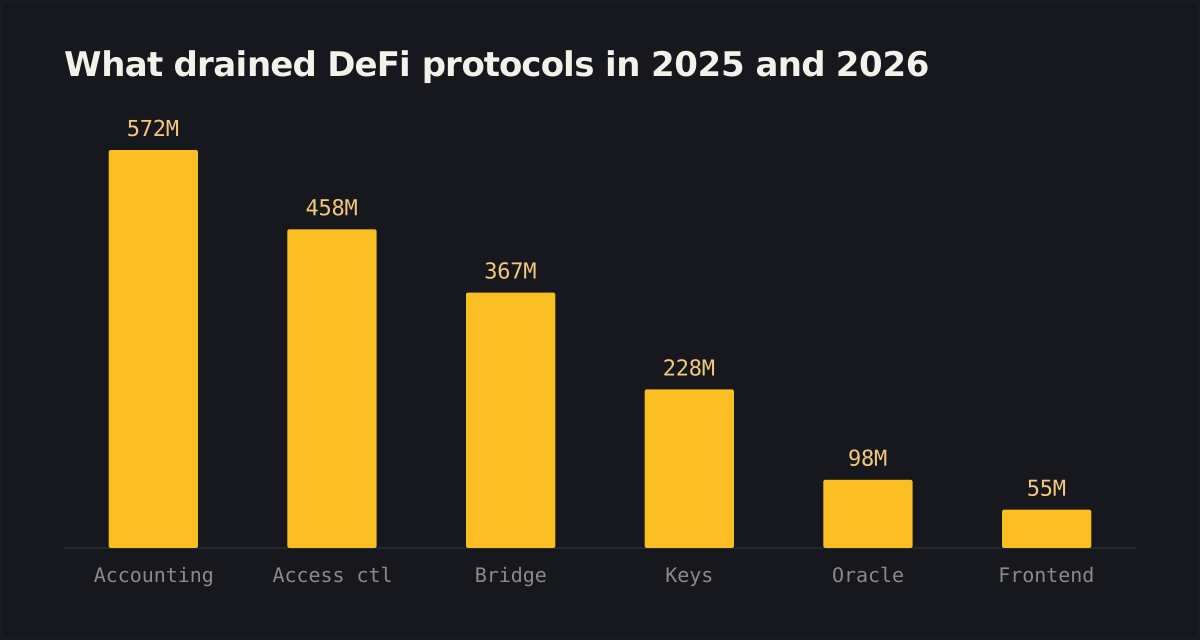
Since 2016, DeFiLlama's hack database has recorded 920 incidents at DeFi protocols totalling $9.25 billion, inside 1,263 incidents and $20.65 billion across all of crypto. Narrow it to 2025 and 2026 to date and you get 301 DeFi protocol incidents and $1.91 billion, split by the causes above.
The ordering contradicts the folklore, and it's the most useful thing here if you write contracts for a living. Reentrancy, the exploit every introductory course teaches, accounts for $45 million of that $1.91 billion. Errors in how a protocol tracks shares and balances account for $572 million, and broken access control, mostly hijacked upgrade paths, for $458 million. The industry got good at the famous bug and stayed mediocre at arithmetic and key management.
The named incidents make the pattern concrete:
- Cetus CLMM, $223 million, 22 May 2025, an arithmetic error in a concentrated-liquidity AMM on Sui.
- Balancer v2, $128 million, 3 November 2025, a rounding error that reached deployments on six chains at once.
- Drift Trade, $295 million, 1 April 2026, a hijacked proxy upgrade on Solana. No logic flaw needed; control of the upgrade path was enough.
- Kelp, $293 million, 18 April 2026, spoofed cross-chain messages between Ethereum and Arbitrum.
- Tectonic, $124.5 million, 30 August 2026, a donation attack on Cronos, a share-accounting failure of the kind the chart's largest bar describes.
Three of those five were not contract logic bugs in the classic sense. They were upgrade authority, message authentication and share accounting. That is where review effort belongs, and it is the argument we make at length in our guide to blockchain security.
DeFi regulation in 2026
Regulation is no longer a wildcard, but the map still has two large blank regions. Here is what was settled on 10 September 2026 and what was not.
MiCA is in force, and DeFi sits outside it for now
The EU's Markets in Crypto-Assets Regulation, Regulation (EU) 2023/1114, has applied since December 2024. It covers asset-referenced tokens, e-money tokens, other crypto-assets outside existing financial legislation, and crypto-asset service providers, with authorisation and disclosure requirements attached. ESMA records that the Article 143(3) grandfathering clause, which let firms operating under national law before 30 December 2024 carry on without MiCA authorisation, ran out on 1 July 2026.
DeFi is explicitly outside the perimeter. Recital 22 states that where crypto-asset services are "provided in a fully decentralised manner without any intermediary, they should not fall within the scope of this Regulation." Nobody has ever agreed on what "fully decentralised" means, which is the whole debate.
The European Commission put that question formally on the table. Its targeted consultation on the review of MiCA opened on 20 May 2026 and, after an extension, remains open to replies until 30 September 2026. Part 4 asks whether and how to complement MiCA on DeFi, and one question lists the candidate tests for deciding a protocol is not fully decentralised: an identifiable intermediary, control over key functionality through admin keys or upgradeability, concentrated governance power, custody of user assets, closed-source code, and marketing by an identifiable entity. No legislative proposal has followed. For anyone building for EU users, those six criteria are the best preview of the line that exists.
The United States: one law not yet in force, one bill not yet passed
Two things are frequently reported as done and are not.
Stablecoins. The GENIUS Act became Public Law 119-27 on 18 July 2025, creating a federal regime for payment stablecoins with permitted issuers, full reserve backing and monthly disclosure. Section 20 sets the effective date at the earlier of 18 months after enactment or 120 days after the primary federal regulators issue final implementing rules. As of 10 September 2026 every GENIUS implementation document in the Federal Register was still a proposed rule, including Treasury's proposal on issuance, offer and sale published 18 August 2026, comments open to 19 October. The law is settled; its operative date lands no later than 18 January 2027. The ban on service providers offering non-permitted stablecoins runs on a separate three-year clock.
Market structure. The CLARITY Act, H.R. 3633, passed the House and reached the Senate on 18 September 2025. Senate Banking reported it with a substitute amendment on 1 June 2026. The Government Publishing Office holds no engrossed-in-Senate or enrolled version, so it had not passed the Senate and was not law on 10 September 2026. Plenty of vendor blogs say otherwise. They're wrong.
The substitute matters more than its status suggests, because it is the clearest drafting anyone in Washington has produced on DeFi. Its Title III is titled "Responsible Innovation in Decentralized Finance." It defines a decentralized finance trading protocol as a distributed ledger system where participants transact under a predetermined, non-discretionary rule with nobody but the user holding custody. A non-decentralized finance trading protocol is then one where somebody can control or materially alter the functionality, or where operation does not run solely on transparent rules encoded in the source code, or where somebody can restrict or censor use. Those are the ones the bill would regulate.
Notice how closely that tracks the Commission's six criteria. Two jurisdictions drafting independently landed on the same test: control, not branding. Separately, the SEC and CFTC issued a joint interpretation on applying the federal securities laws to crypto assets, effective 23 March 2026, which moved the ground under classification ahead of any statute.
What this means for builders. Admin keys, upgradeability and a controllable front end are no longer neutral engineering conveniences. In both drafts they are the trigger. Sitting outside the intermediary perimeter means giving up the ability to intervene, and giving it up before a regulator asks.
Where DeFi is heading, by the numbers
Every trend below carries a measured figure or a named deployment. Anything that could not clear that bar is not here.
Tokenised treasuries and real-world assets. rwa.xyz tracked $15.86 billion of tokenised US Treasuries across 101 products and 74,253 holders on 10 September 2026, down 2.36% over 30 days. DeFiLlama's wider real-world asset category, which also counts tokenised gold, private credit and CLO funds, showed $28.33 billion across 139 protocols, with BlackRock's BUIDL alone at $3.59 billion. The hard problems are legal, not technical: enforceability of the claim, attestation quality, redemption under stress. Our piece on real-world asset tokenization works through them.
Restaking is smaller than the noise around it suggests. DeFiLlama's restaking category held $9.99 billion across 13 protocols on 10 September 2026, led by EigenCloud at $6.49 billion and Babylon at $3.21 billion. The pitch is that a new service rents an existing security budget instead of bootstrapping its own. The risk is that one pool of staked capital backing many services turns an isolated slashing event into a correlated one.
Then there are intents. Instead of specifying a route, the user states an outcome and competing solvers work out the execution. CoWSwap, the largest intent-based venue, did $3.30 billion of 30-day volume against $70.4 billion across all DEX aggregators. Real, and not yet dominant. The open question is whether solver markets stay open, since a small set of sophisticated solvers handling most flow is an intermediary by another name.
Liquidity fragmentation across layer 2s. L2Beat listed 104 live Ethereum layer 2s securing $49.3 billion on 10 September 2026. Base and Arbitrum One held 55% between them, the top three held 68.5%, and 85 of the 104 secured under $100 million each. The median chain secured $9.5 million. Design for multiple chains from the first commit, and treat every cross-chain hop as a trust assumption you have to justify. The Kelp incident is what an unjustified one costs.
Institutional access on open rails. The working pattern is a permissioned pool on permissionless infrastructure: open settlement, gated membership. Aave's Horizon RWA market held $260 million on 10 September 2026 against Aave's $18.1 billion total, and tokenised money-market funds from BlackRock, Ondo, Circle, WisdomTree and Invesco all appear in DeFiLlama's rankings. This is not the censorship-resistant ideal. It is the compromise that brings balance-sheet capital.
Where the numbers disagree, and why
Two trackers can report the same quantity and differ by a multiple. Both can be right. Averaging them destroys the information that made the gap interesting.
Total value locked. DeFiLlama's headline DeFi TVL was $87.5 billion on 10 September 2026. Sum the TVL of every non-exchange protocol in the same dataset and you get $285.6 billion, more than three times as much. Neither is an error. DeFiLlama's methodology excludes double counting, where a receipt token from one protocol is deposited into another, and keeps liquid staking out of chain TVL so a single staked ETH is not counted twice. The headline is deduplicated; the sum is not. When two TVL numbers sit far apart, the question is not which is accurate but which is deduplicated.
Losses to theft. Chainalysis reported over $3.4 billion stolen from January to early December 2025, with $2.02 billion attributed to North Korea-linked actors and 20% of the value taken from personal wallets. DeFiLlama's database, on a full-year 2025 basis, records $2.71 billion across all incident types and $756 million specifically at DeFi protocols. The gap is scope, not accuracy: Chainalysis counts personal wallet compromises and applies its own attribution, and the $1.4 billion Bybit theft in February 2025 is a large share of both totals while being an exchange breach, not DeFi. Pick the figure that matches your question. For how risky the ecosystem is, use Chainalysis. For how risky depositing into a protocol is, use the DeFi-protocol subset, which was about a fifth of the headline.
Tokenised assets. rwa.xyz's $15.86 billion counts tokenised US Treasuries. DeFiLlama's $28.33 billion counts a broader real-world asset category including gold and private credit. They are measuring different sets, and a chart that puts them on one axis is wrong before it is drawn.
What this means if you are building on DeFi
If you are building on DeFi rather than using it, the interesting work is nowhere near the yield. It is in the four places the measured data keeps pointing at: share accounting, upgrade authority, cross-chain message authentication and oracle integration. Those four causes carry about four fifths of the $1.91 billion lost at DeFi protocols since the start of 2025. A protocol that gets them right and ships an ordinary feature set will outlive one that gets them wrong and ships a clever one.
Regulation adds a second design constraint that used to be optional. Both the EU consultation and the US Senate substitute draw the perimeter around control: admin keys, upgradeability, custody of user assets, the ability to restrict use. Decide early which side of that line you sit on, because retrofitting decentralisation after launch is close to impossible and retrofitting compliance onto an immutable contract is worse.
Our blockchain development practice builds this layer for a living. SeedBox, a crypto venture-investing platform, is the shape of the work: Solidity contracts with Ethers.js and Web3.js, a React front end over an AdonisJS and PostgreSQL backend, individual investor wallets, fiat and crypto on-ramps in one onboarding flow, KYC verification built into the investor profile rather than bolted alongside it, dynamic investment pools, and token-holder governance. It started at the idea stage from a product requirement document rather than a deck, and the MVP shipped. For the wider stack around a build like that, our overview of web3 development sets the context.
Decentralized finance turned out smaller than its promoters promised and far more durable than its critics expected. What exists now is a set of working financial primitives with published rules, real capital, a measurable failure record and a regulatory perimeter being drawn around control rather than vocabulary. Understand what is DeFi at that level and you will make better calls than any forecast will give you.
Frequently asked questions
DeFi, short for decentralized finance, is financial services that run as programs on a public blockchain instead of inside a company. Lending, trading and saving are performed by smart contracts that hold the funds and enforce the rules. You keep your assets in your own wallet, nobody approves your account, and anyone can read the code that decides what happens to the money.
A smart contract is a program deployed to an address on a blockchain, made of code and stored data. Ethereum's documentation describes it as a collection of code and data that lives at a specific address. It runs the same way on every node, anyone can call it, its bytecode is public, and by default it cannot be deleted and its effects cannot be reversed.
You sign a transaction with the private key in your wallet and broadcast it. A smart contract receives the call, checks the conditions, reads a price from an oracle if it needs one, and moves tokens between balances it controls. Validators include the transaction in a block and every state change settles at once. If any step fails, the whole sequence reverts and you lose only the gas.
Safer than it was, still riskier than a bank account, and the honest answer depends on which protocol. DeFiLlama's hack database recorded 920 incidents at DeFi protocols and 9.25 billion dollars lost since 2016 when we read it on 10 September 2026. Narrowed to 2025 and 2026 to date, 301 incidents cost 1.91 billion, and the biggest causes were share-accounting bugs, hijacked upgrade paths and cross-chain message spoofing rather than the blockchain itself. There is no deposit insurance and no way to reverse a transaction, so the risk you accept is the code plus your own key handling. Long-lived audited protocols that have held large balances for years carry meaningfully less of it than new ones, but never zero.
Yield farming means moving crypto between DeFi protocols to earn a return: trading fees from a pool you supplied, interest paid by borrowers in a lending market, or newly minted tokens a protocol hands out to attract deposits. The first two track real economic activity and tend to hold up. The third decays as emissions dilute the token you are being paid in.
Impermanent loss is the gap between holding two tokens and supplying them to a constant-product pool once their prices diverge. It follows from the pool formula: 2 times the square root of the price ratio, divided by 1 plus that ratio, minus 1. A 2x divergence costs about 5.7 percent before fees, a 4x divergence about 20 percent. Fees can offset it. For volatile pairs they often do not.
CeFi means a company holds your crypto, so you get an account, a support desk and a counterparty that can fail. DeFi replaces the company with smart contracts, so nobody can freeze your position and nobody can help you recover a mistake either. The dividing line is custody, not whether a product looks like crypto or calls itself decentralized.
Partly. In the EU, MiCA has applied since December 2024 and its Recital 22 leaves crypto-asset services provided in a fully decentralised manner without any intermediary outside its scope; the Commission is running a targeted consultation on whether to change that, with the reply deadline extended to 30 September 2026. In the US the GENIUS Act on stablecoins is law but not yet in effect, and the CLARITY market-structure bill had not passed the Senate as of 10 September 2026.
More from the journal

Smart Contract Development: Lifecycle, Patterns, Cost
Smart contract development is mostly verification, not typing. This guide walks the lifecycle from specification to monitoring, with Solidity code, a language and chain comparison, exploit losses measured from DeFiLlama, and what an audited build costs.

Tokenomics: How to Design a Token Economy That Holds Up
Tokenomics is the design of a token's supply, distribution, vesting and demand. This is a founder's guide to designing one: the components, benchmark allocations from 150+ launches, dated examples from Ethereum to Terra, and a step by step method.

Decentralized Exchange Development: Architecture and Cost
A build guide for decentralized exchange development: how AMM, order-book and intent designs differ, what the architecture really contains, what a fork costs you in licence terms, and a cost model with its assumptions written down.